A Solana private mempool means sending transactions through Jito as bundles straight to Jito validators, skipping the public path where bots can see them first. Solana has no public mempool like Ethereum, yet transactions can still be sandwiched or sniped by bots watching the transaction flow; Jito bundles (bundleOnly mode) prevent this in exchange for a small SOL tip.
← All articles · Baca dalam Bahasa Indonesia
Solana Private Mempool (Jito): How to Avoid Sandwiches & Snipers
November 11, 2026
Solana private mempool via Jito: why Solana transactions can still be sandwiched, how bundles and bundleOnly work, how to enable it on BaniPool, tip costs, and the limits.
A Solana private mempool protects your swaps and pool creation from sandwiches and snipers. Many assume Solana is immune because it has no public mempool like Ethereum. In reality, Solana transactions are forwarded to upcoming leaders (the validators producing blocks) — and bots can see them along the way before they land. BaniPool sends Solana transactions through Jito with a small tip so they are not broadcast before landing.
Threats it prevents
- Sandwich — a bot buys right before your swap (price goes up) and sells right after. You get the worst price your slippage allows.
- New-pool sniping — once a create-pool transaction is visible, bots buy first or move the price before your liquidity lands.
How Jito works
Jito is the validator client used by most Solana stake. Jito accepts bundles — groups of transactions executed sequentially and atomically — directly from the sender, without broadcasting them. The sender pays a tip to the validator. BaniPool uses two methods:
- Single transactions (swap, Zap In, add/remove liquidity, claim fees): the tip is embedded in the transaction, which is sent in bundleOnly mode after being simulated. If Jito fails, the transaction is sent through a normal RPC and you are told.
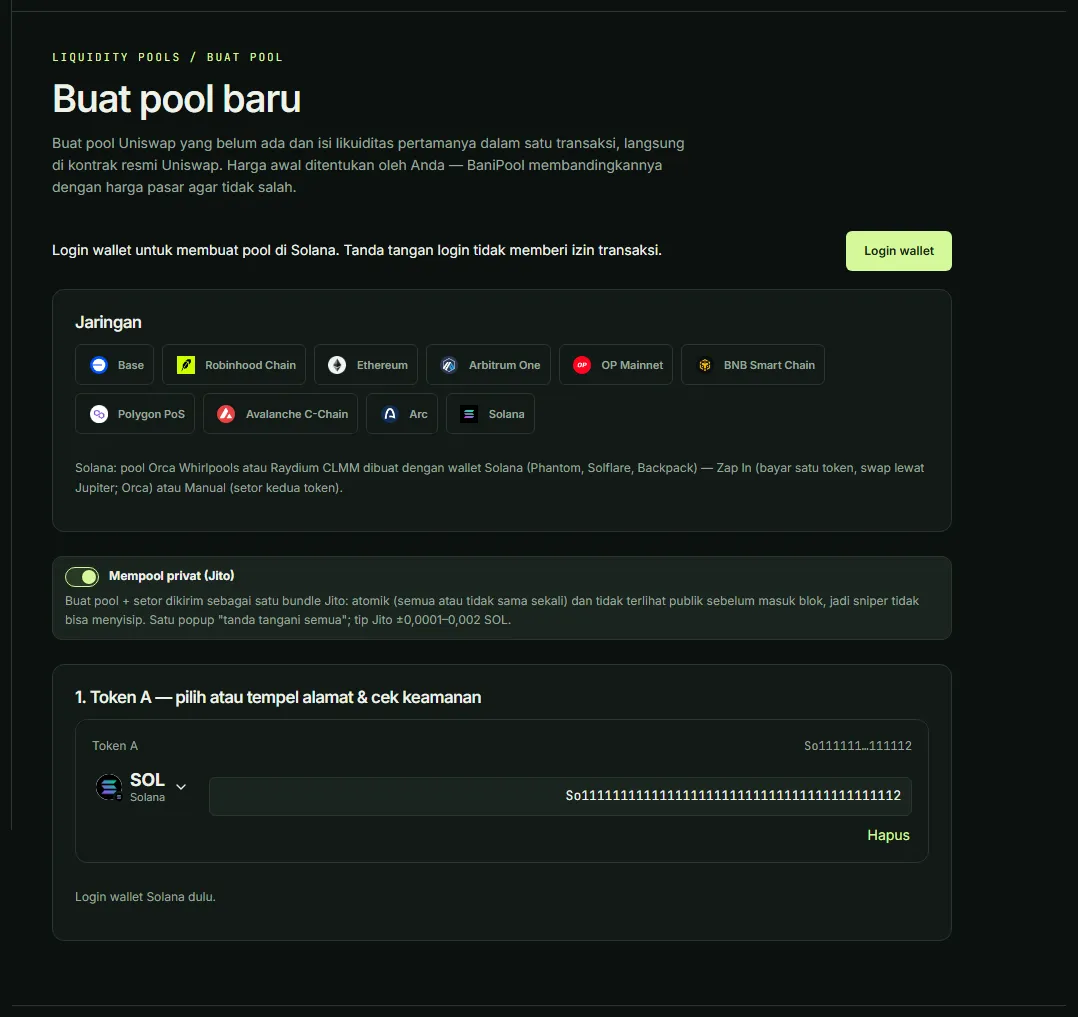
- Create pool: pool creation + first deposit + tip are sent as one atomic bundle — see how to create a Solana liquidity pool.
How to enable it on BaniPool
- Log in with a wallet that supports "sign only": Phantom, Solflare or Backpack.
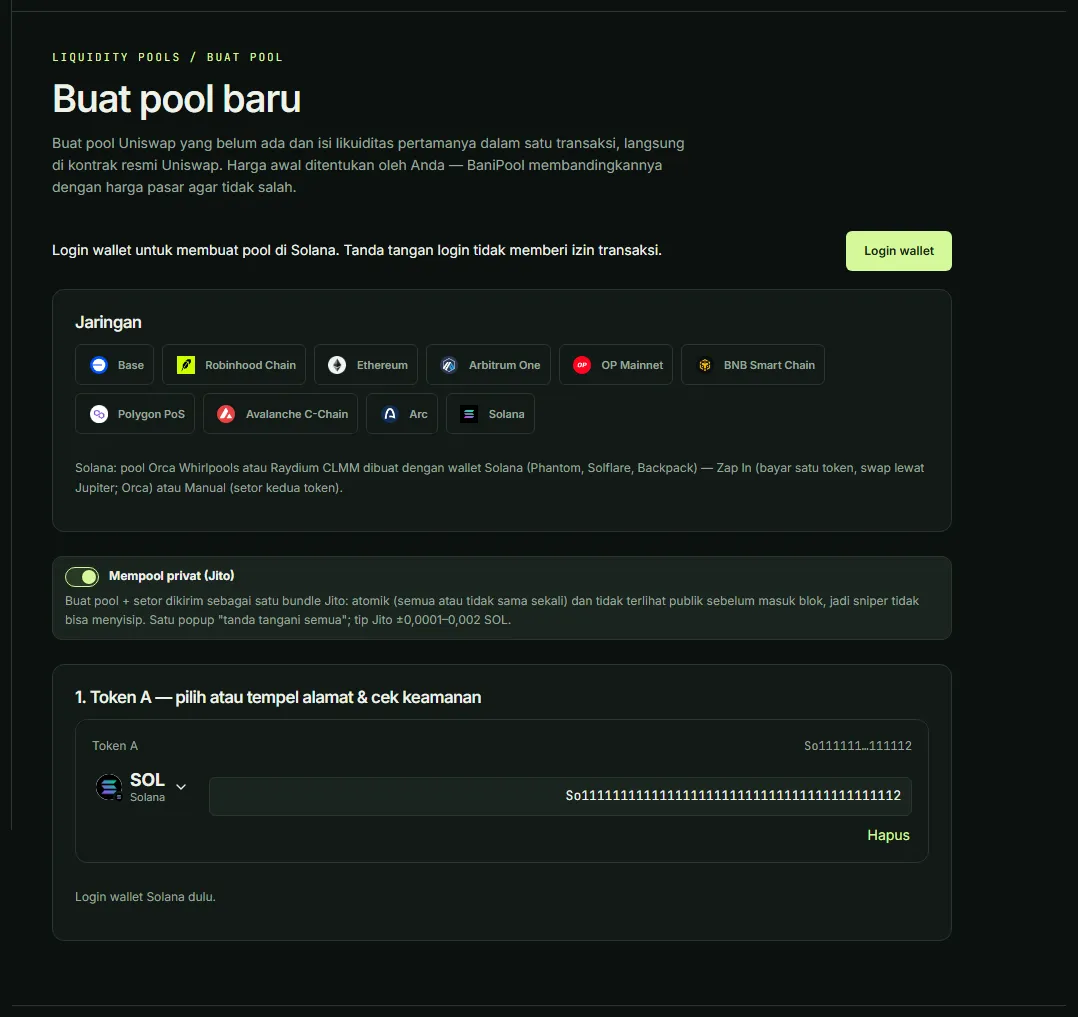
- Open ⚙ (slippage settings) in any Solana dialog — Swap, Zap In, add liquidity — or the Private mempool (Jito) switch on the Create pool page.
- Slide it right. It applies to all BaniPool Solana transactions in that browser.
- Once confirmed, transactions in Transaction history are labeled 🛡 Private mempool with a link to the bundle on the Jito explorer.
Cost
| Item | Amount |
|---|---|
| Jito tip | Current 75th-percentile tip, capped at 0.0001–0.002 SOL (usually ~0.0001 SOL) |
| BaniPool fee | None |
| Failed create-pool bundle | No funds move |
Honest limits
- It hides a transaction before it lands; once confirmed, the transaction and pool are public on Solscan.
- The validator producing the block still sees the transaction.
- Wallets that always send their own transactions cannot use this path; BaniPool tells you and uses the normal path.
- Sensible slippage is still needed.
FAQ
Does Solana have a mempool?
Not a public one like Ethereum, but transactions forwarded to leaders can be observed before they land — enough for sandwich bots.
When should I use the private mempool?
Always when creating a pool for a new token, and when swapping or Zapping small/volatile tokens in size.
What about Ethereum and BNB Chain?
On EVM, protection comes from a private RPC in your wallet — see what is a sandwich attack.
Related articles
How to Add Liquidity on Solana: Orca, Raydium, Meteora & PumpSwap
Add liquidity on Solana across 6 DEXes — Orca Whirlpools, Raydium CLMM/CPMM, Meteora DLMM/DAMM v2, PumpSwap — with account rent explained, SOL Zap In and a Jito private mempool.
How to Create a Solana Liquidity Pool on Orca & Raydium Without Snipers
Create a Solana liquidity pool for your token on Orca Whirlpools or Raydium CLMM: SOL costs, initial price, Zap In, and an atomic Jito bundle so sniper bots cannot front-run you.
Impermanent Loss Calculator & Liquidity Pool Simulator (No Wallet)
Calculate impermanent loss for full-range and concentrated liquidity (Uniswap v3, Orca): a table per price change, the effect of range width, and a free LP simulator without a wallet.