Impermanent loss is the gap between an LP position's value and simply holding both tokens; for a full range the formula is IL = 2·√r ÷ (1 + r) − 1 (a 2× price move → −5.72%), while a concentrated range such as ±10% earns about 20× more fees per dollar but also carries larger impermanent loss. The BaniPool LP simulator calculates both with real pool data, no wallet needed.
← All articles · Baca dalam Bahasa Indonesia
Impermanent Loss Calculator & Liquidity Pool Simulator (No Wallet)
November 11, 2026
Calculate impermanent loss for full-range and concentrated liquidity (Uniswap v3, Orca): a table per price change, the effect of range width, and a free LP simulator without a wallet.
Before depositing into a liquidity pool there are two key questions: how much fee income you might earn and how much you could lose if the price moves. The calculator below — and the BaniPool LP simulator — answers both with real pool data, without a wallet or any transaction.
The impermanent loss formula
For a full-range pool (x·y=k, like Uniswap v2 or Raydium CPMM), with r = new price ÷ starting price:
IL = 2·√r ÷ (1 + r) − 1
For concentrated liquidity (Uniswap v3/v4, Orca, Meteora DLMM), capital sits in a chosen price range. Fees per dollar are far higher while the price stays in range, but impermanent loss is larger too, and once out of range the position becomes a single token.
Impermanent loss table (before fees)
Position value compared with simply holding both tokens (HODL). * = the price is outside the range (the position earns no fees).
| Price change | Full range | ±25% range | ±10% range |
|---|---|---|---|
| −50% | −5.72% | −30.32%* | −32.54%* |
| −25% | −1.03% | −8.42%* | −12.46%* |
| −10% | −0.14% | −1.15% | −2.83%* |
| +10% | −0.11% | −0.95% | −2.32%* |
| +25% | −0.62% | −5.24%* | −8.55%* |
| +50% | −2.02% | −13.79%* | −17.34%* |
| +100% | −5.72% | −26.98%* | −30.66%* |
Capital concentration vs full range: ±25% ≈ 8.3×, ±10% ≈ 20.4×, ±5% ≈ 40.5×. While the price stays within ±10%, each dollar earns roughly 20 times more fees than in a full range — that is the reward for the larger risk.
How to use the LP simulator
- Open banipool.com/simulasi or the Simulate without a wallet card on any pool page.
- Pick a pool, enter an amount, a range width and a duration (7, 30 or 90 days).
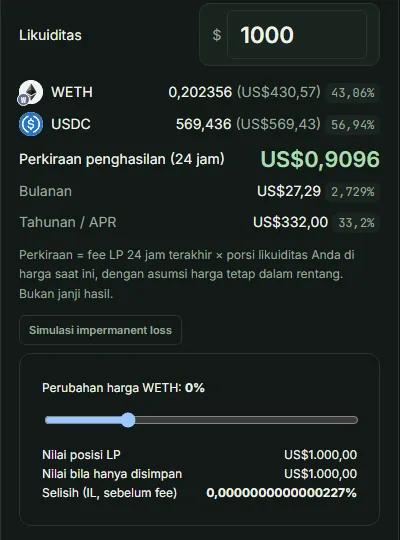
- See the estimated fees (pool fee APR × duration × share of time the price stayed in your range over the last 7 days) and the position value if the price moves table.
If the result works for you, add real liquidity from the same pool page.
FAQ
Is impermanent loss guaranteed?
No. Impermanent loss is only realised if you withdraw while the price differs from the starting price. If the price returns to where it started, the gap disappears, and collected fees can offset it.
Why is a narrow range riskier?
Because the position turns into a single token faster as the price moves, and once out of range it stops earning fees. In exchange, fees per dollar are much higher while the price is inside the range.
Does the simulator need a wallet?
No. It runs in your browser with public pool data and never creates a transaction.
Related articles
Impermanent Loss Explained: Formula, Examples Table & How to Reduce It
Impermanent loss is the gap between an LP position and simply holding the tokens. Formula, a loss table by price change, concentrated liquidity effects, and 7 ways to reduce it.
Liquidity Pool Rug Pull Warning Signs: Collapsing TVL, Token Authorities & How to Protect Your Position
Spot rug-pull warning signs before and after depositing into a liquidity pool: collapsing TVL, mint/freeze authority, large holders, honeypots, fake volume — and how to protect your LP position.
BaniPool vs Revert Finance vs Krystal vs DeBank: Which LP Tool Fits You?
A neutral comparison of BaniPool, Revert Finance, Krystal and DeBank for liquidity providers: tool type, networks, adding liquidity, automation, and when to pick which.