Quick answerImpermanent loss is the difference in value between depositing two tokens into a liquidity pool and simply holding the same tokens in your wallet. It happens because the AMM keeps rebalancing the pool as prices move; for an x·y=k pool the formula is IL = 2√r / (1 + r) − 1, where r is the price ratio change.
Examples: price 2× → about 5.7% IL; 3× → about 13.4%; 5× → about 25.5%. It is called "impermanent" because it disappears if the price returns to the starting point, and swap fees can offset it when pool volume is high enough.
BaniPool data as of November 13, 2026: the median fee APR of large pools (TVL ≥ $1M) is 34.9% per year — a benchmark for how much fee income is available to offset impermanent loss.
Live data from the BaniPool index (pools with TVL ≥ $1M), refreshed every 30 minutes — full DeFi liquidity report
Impermanent loss is the gap between an LP position and simply holding the tokens. Formula, a loss table by price change, concentrated liquidity effects, and 7 ways to reduce it.
Impermanent loss is the difference between the value of your liquidity pool position and what you would have if you had simply held both tokens in your wallet. It appears whenever one token moves in price relative to the other. It is called impermanent because it disappears if the price returns to where it started — but it becomes real when you withdraw at a different price. This guide covers the impermanent loss formula, an examples table, how concentrated liquidity amplifies it, and how to reduce it.
Why impermanent loss happens
An AMM pool always keeps the value of both sides balanced. When ETH rises on the market, arbitrage bots buy cheap ETH from the pool until the pool price matches the market. The pool — and your position — ends up with less ETH and more USDC. You effectively sold ETH on the way up. When the price falls, the opposite happens: the pool buys the falling asset.
Impermanent loss formula
For x·y=k pools (Uniswap v2, Raydium CPMM, PumpSwap), with r = final price ÷ initial price:
IL = 2 × √r ÷ (1 + r) − 1
Impermanent loss table
| Token price change | Impermanent loss |
|---|
| Up 25% (r = 1.25) | −0.6% |
| Up 50% (r = 1.5) | −2.0% |
| Up 2× (r = 2) | −5.7% |
| Up 3× (r = 3) | −13.4% |
| Up 5× (r = 5) | −25.5% |
| Down 50% (r = 0.5) | −5.7% |
| Down 90% (r = 0.1) | −42.5% |
Direction does not matter — distance does. A 2× rise and a 50% drop give the same IL (−5.7%).
Remember: this is relative to HODL, not your initial capital. If ETH doubles, your LP position is still up in dollars — just 5.7% less than if you had held ETH and USDC.
Impermanent loss in concentrated liquidity
On Uniswap v3/v4, Orca Whirlpools, Raydium CLMM and Meteora DLMM, capital is concentrated in a range. The effect is amplified: more fees per dollar, but larger impermanent loss within the range. Once the price leaves the range, the position is entirely the token that lost value — and it stops earning fees. Narrow ranges suit stable pairs or LPs who actively manage positions.
When do fees cover impermanent loss?
An LP position beats HODL when accumulated fees > impermanent loss. Example: a pool with 50% Fee APR earns about 4.2% per month. If the price moves 2× in that month (IL −5.7%), fees do not cover it; if it moves 1.5× (IL −2.0%), they do, with room to spare.
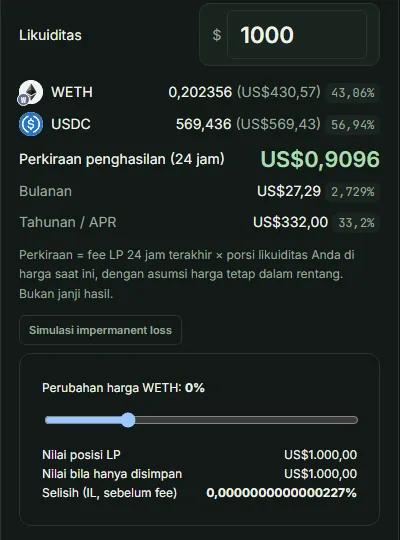
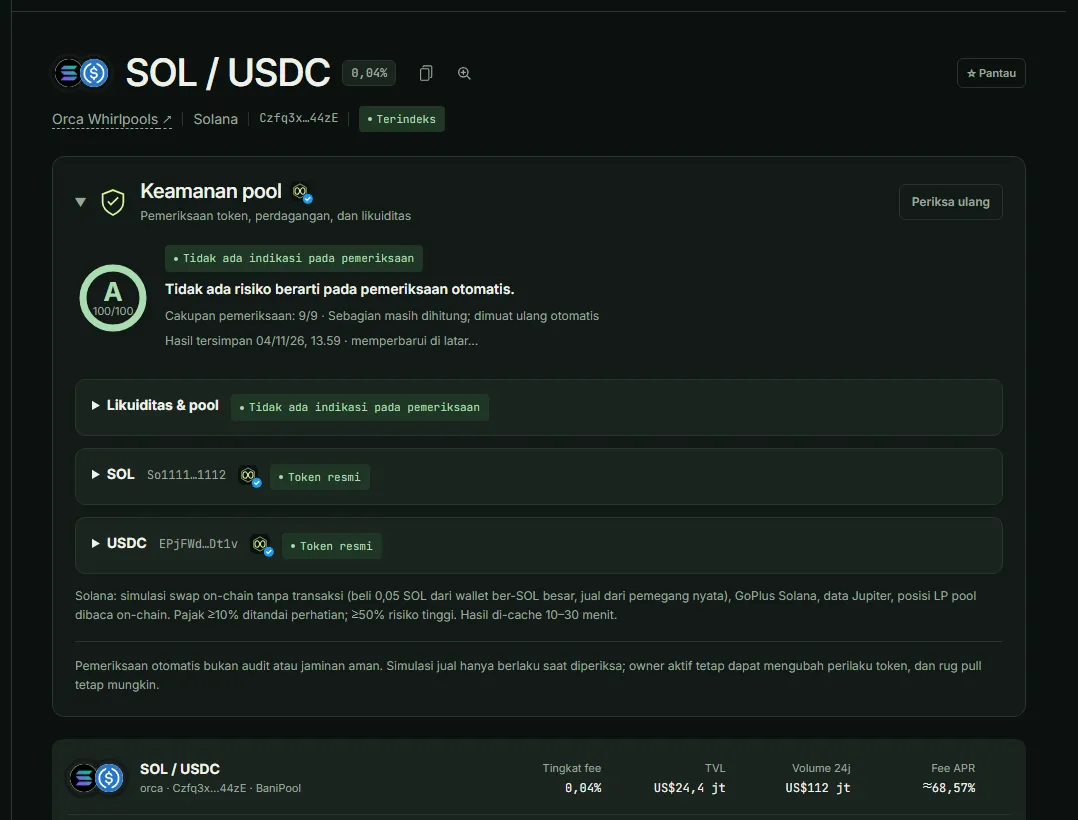
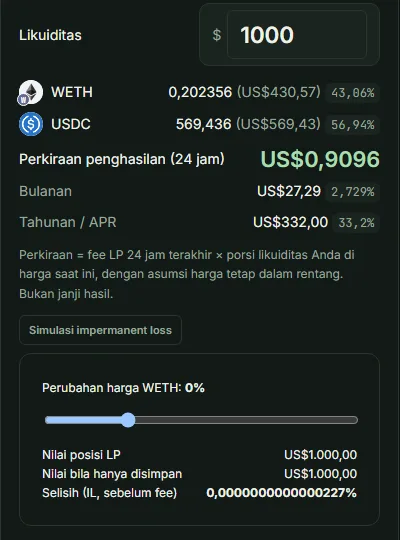
On BaniPool, pool pages include an impermanent loss simulator and range backtest, and position pages show PnL vs HODL, so you can see these numbers for your own position.
7 ways to reduce impermanent loss
- Choose correlated pairs — stablecoin/stablecoin (USDC/USDT) or similar assets (SOL/JitoSOL, ETH/wstETH).
- Pick pools with high volume relative to TVL — fees cover IL faster.
- Use wider ranges for volatile pairs.
- Use higher fee tiers (0.3%–1%) for volatile tokens.
- Rebalance automatically when out of range — see automated LP rebalancing.
- Avoid brand-new tokens that can drop 90% in a day — fees will not cover that.
- Use low-gas networks (Base, Arbitrum, Solana, BNB Chain) so managing ranges stays cheap.
FAQ
Can impermanent loss be avoided completely?
No, unless the two assets never move relative to each other. You can only reduce it and make sure fees exceed it.
Does impermanent loss happen when prices fall?
Yes. The formula is symmetric: a 50% drop produces the same IL as a 2× rise.
When does impermanent loss become permanent?
When you withdraw liquidity at a price different from your entry price.
How can I see impermanent loss on my position?
Open your position on BaniPool: the performance card shows position value, fees and PnL versus HODL.