PumpSwap fees are tiered by the token's market cap: traders pay about 1.25% per swap in total, but liquidity providers receive only about 0.02% while the market cap is below roughly 420 SOL — the rest goes to the protocol and the token creator. PumpSwap APR must therefore be calculated from the LP share, not the total fee traders pay; without that correction APR looks far higher than it really is.
← All articles · Baca dalam Bahasa Indonesia
PumpSwap Fees Explained (2026): Why LPs Get Only 0.02% at First
November 11, 2026
PumpSwap fees are tiered by market cap: traders pay 1.25% but LPs get only 0.02% below ~420 SOL. Table of LP, protocol and creator shares, and how to compute APR correctly.

PumpSwap fees are widely misunderstood. Many people assume a flat 0.25% fee, but for tokens that graduated from the Pump.fun bonding curve, PumpSwap fees are tiered by market cap — and the share for liquidity providers starts tiny: 0.02% of a 1.25% total fee. This article shows the numbers BaniPool reads directly from the Pump fee program on-chain, how to compute APR correctly, and when adding liquidity on PumpSwap makes sense.

PumpSwap fee table (read on-chain)
| Token market cap | Total trader fee | LP | Protocol | Creator |
|---|---|---|---|---|
| < ~420 SOL | 1.25% | 0.02% | 0.93% | 0.30% |
| ≥ ~420 SOL | ~1.20% → 0.30% | 0.20% | 0.05% | 0.95% → 0.05% |
| Non-Pump.fun pool | 0.30% | 0.25% | 0.05% | 0% |
While market cap is small, traders pay 1.25%, but only 0.02% goes to LPs — most goes to the protocol and creator. Above ~420 SOL market cap, the LP share rises to 0.20% and the creator share declines gradually.
Non-migration example: USDC/SOL PumpSwap 0.3% (BaniPool data, November 10, 2026) — TVL $5.1M, 24h volume $4.5M, Fee APR ~96.1% with a 0.25% LP share.
How to compute PumpSwap APR correctly
Fee APR = 24h volume × LP fee × 365 ÷ TVL
Example: a small token with $500K volume and $50K TVL.
- Using the 1.25% total fee → APR appears to be 4,562%.
- Using the real 0.02% LP fee → APR is ~73%.
BaniPool always computes Est. Fee APR from the LP share, not the total fee. More: liquidity pool APR explained.
On BaniPool
When you open a PumpSwap pool (from the explorer or new pool Radar), you see:
- the total fee tier for traders;
- the fee breakdown — LP, protocol and creator shares, read on-chain;
- Est. Fee APR from the LP share;
- the pool's security grade and a Detected scam category when danger signals appear.
Adding liquidity on PumpSwap: positions are LP tokens (Token-2022) in your wallet, and fees accrue directly into position value. Steps in how to add liquidity on Solana.
When does adding liquidity on PumpSwap make sense?
- The token is above ~420 SOL market cap (0.20% LP share).
- Volume has been steady for several days, not a one-day spike.
- Security grade A–B and holders are not concentrated.
- You accept large impermanent loss — new tokens can drop 90% in a day.
FAQ
What is the PumpSwap fee?
For Pump.fun-graduated tokens: 1.25% total below ~420 SOL market cap, gradually falling to 0.30%. Non-migration pools: 0.30%.
How much do PumpSwap LPs earn?
0.02% below ~420 SOL market cap, 0.20% above it, and 0.25% in non-migration pools.
Why do other sites show much higher PumpSwap APR?
They likely compute it from the total fee instead of the LP share.
Related articles
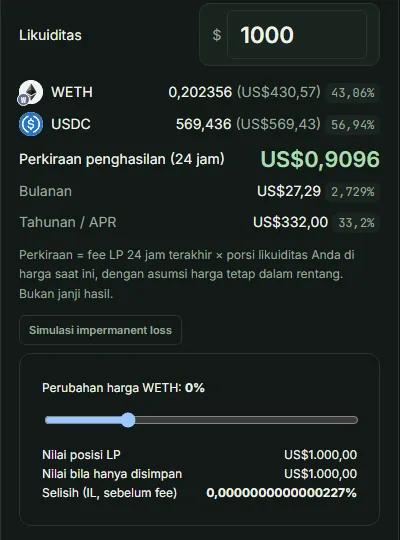
Impermanent Loss Explained: Formula, Examples Table & How to Reduce It
Impermanent loss is the gap between an LP position and simply holding the tokens. Formula, a loss table by price change, concentrated liquidity effects, and 7 ways to reduce it.
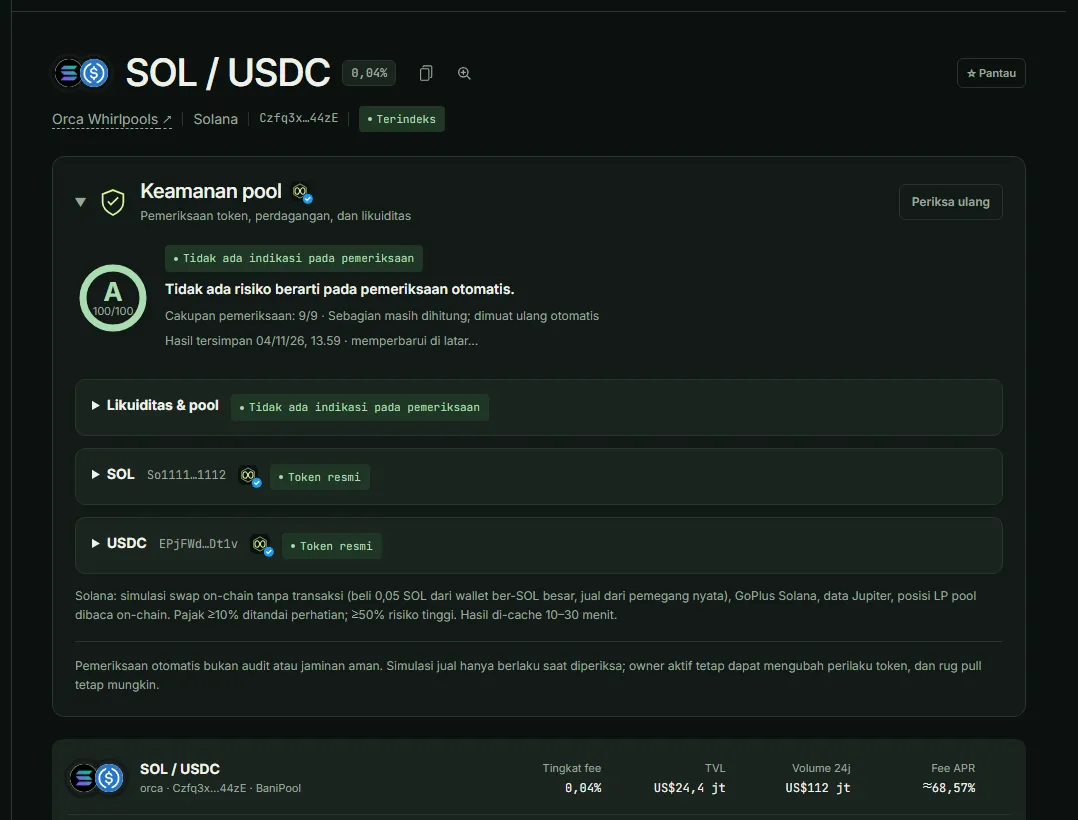
Liquidity Pool APR Explained: Why Can It Show Thousands of Percent?
How to read liquidity pool APR: the Fee APR formula, data sources per DEX (Uniswap, Orca, Raydium, Meteora, PumpSwap), why APR spikes, and 4 ways to use it correctly.
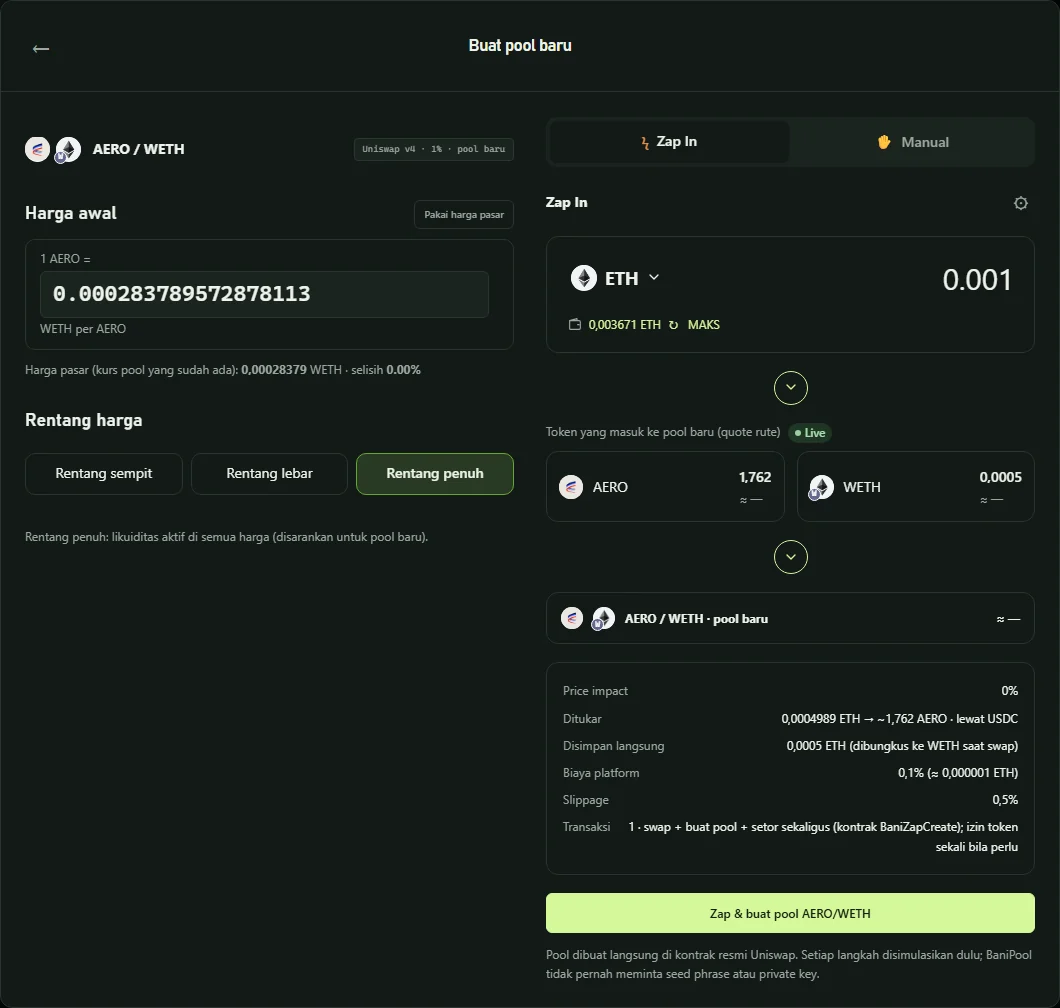
BaniPool Fees & Fund Safety: What Is Free and What Costs
BaniPool fees for swaps, Zap, pool creation, bridge and keeper — including on-chain maximums — plus how your funds stay safe because BaniPool is non-custodial.