Quick answerLiquidity pool APR (fee APR) is an annualised estimate of swap-fee income based on the last 24 hours: fee APR = 24h fees × 365 ÷ TVL × 100%. APR can reach hundreds or thousands of percent when volume spikes briefly or a pool's TVL is tiny, so read it together with TVL, volume and pool age; APR also ignores impermanent loss.
BaniPool data as of November 13, 2026: the median fee APR of large pools (TVL ≥ $1M) is 29.6%, and 8.8% for stablecoin-to-stablecoin pools.
Live data from the BaniPool index (pools with TVL ≥ $1M), refreshed every 30 minutes — full DeFi liquidity report
How to read liquidity pool APR: the Fee APR formula, data sources per DEX (Uniswap, Orca, Raydium, Meteora, PumpSwap), why APR spikes, and 4 ways to use it correctly.
Liquidity pool APR read correctly will save you from the "5,000% APR" trap. APR in a liquidity pool is not a fixed interest rate — it is an annualized estimate of fees earned in the last 24 hours, divided by current liquidity. This article explains the Fee APR formula, where the data comes from per DEX, why the number can reach thousands of percent, and how to use it for decisions.
The Fee APR formula
Fee APR ≈ 24h volume × LP fee × 365 ÷ TVL
Three things matter:
- LP fee, not total fee. On PumpSwap, traders can pay 1.25% while LPs get only 0.02% — see PumpSwap fees explained.
- 24h volume, not a yearly average.
- Current TVL — small TVL inflates APR.
APR data sources per DEX on BaniPool
| DEX | Fee source | APR source |
|---|
| Uniswap v2/v3/v4, Aerodrome | On-chain (BaniPool index) | Observed 24h fees ÷ TVL |
| PumpSwap | On-chain (tiered fee config) | 24h volume × LP fee × 365 ÷ TVL |
| Raydium (CLMM, CPMM) | Official Raydium API | 24h LP-share fee APR |
| Meteora (DLMM, DAMM v2) | Official Meteora API (base + dynamic fee) | 24h volume × LP fee × 365 ÷ TVL |
| Orca Whirlpools | Official Orca API | 24h volume × LP fee × 365 ÷ TVL |
| Pump.fun, Meteora DBC, LaunchLab | — | Not applicable (bonding curves, not LP pools) |
Every pool page shows Data sources — where each number comes from and when it was last updated.
Why can APR reach hundreds or thousands of percent?
Example: a new pool with $100K 24h volume, $2K TVL and a 0.02% LP fee → APR ~365%. With a 0.3% LP fee, APR becomes ~5,475%. Once the first-day hype fades, volume drops and APR collapses — often within hours.
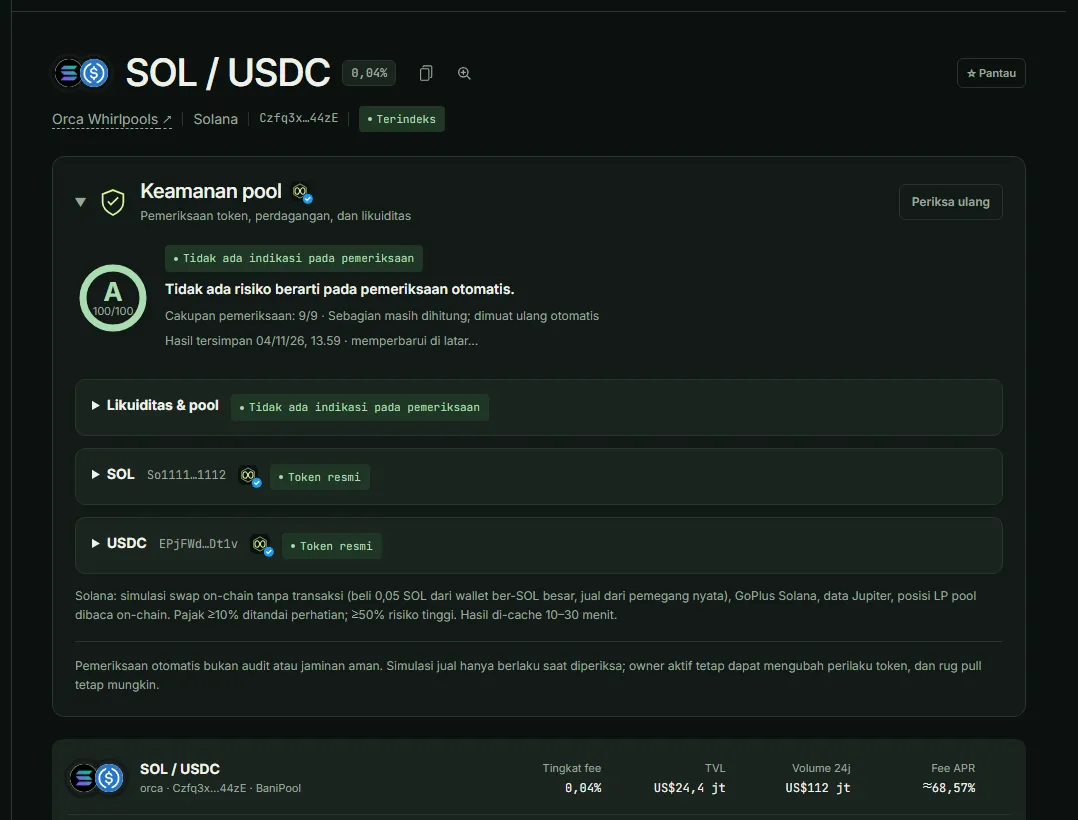
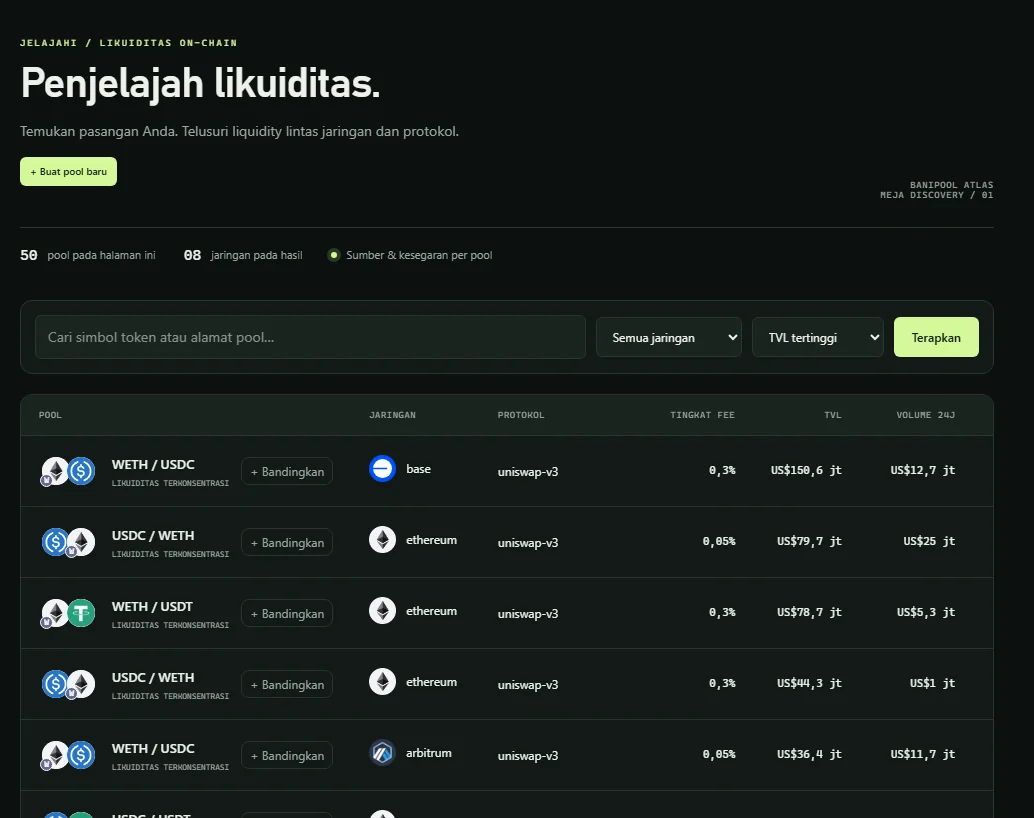
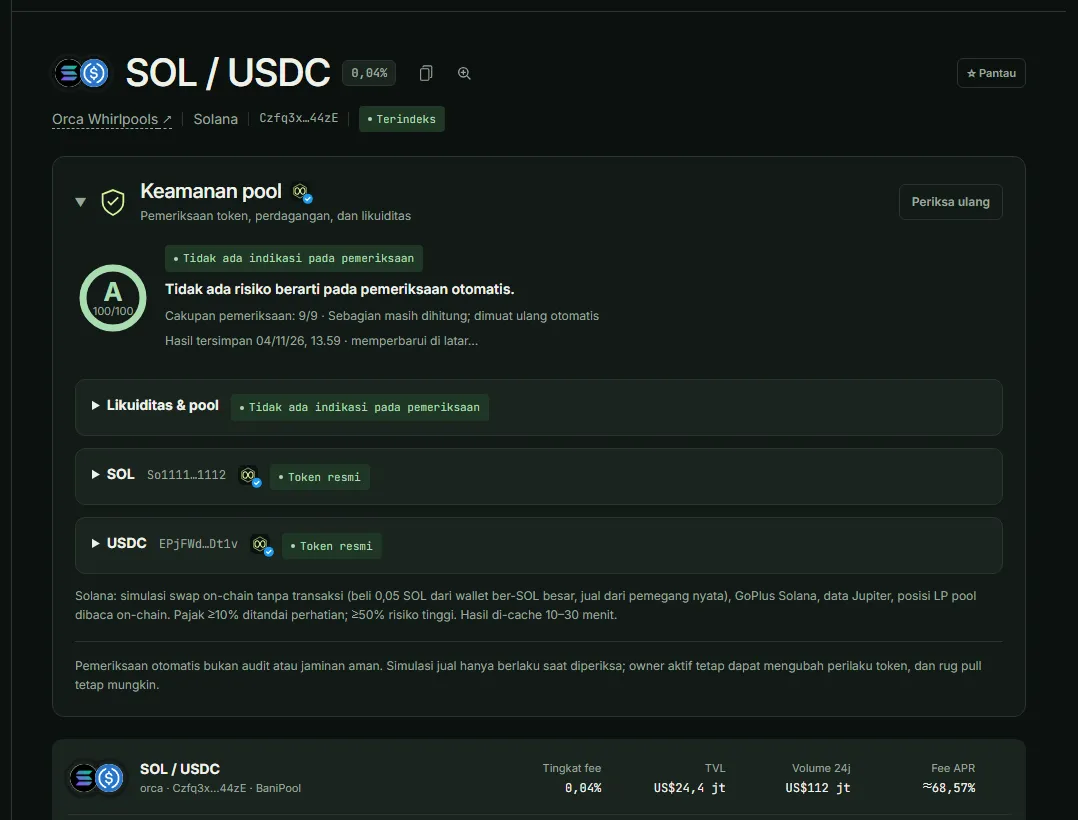
For comparison, healthy large pools (BaniPool data, November 10, 2026): SOL/USDC Orca ~68.9%, WETH/USDC 0.3% on Base ~82.2%, USDC/WETH 0.05% on Ethereum ~49.4%, USDC/USDT 0.01% on Ethereum ~1.4%.
APR vs APY
APR ignores compounding. APY assumes fees are compounded periodically. On BaniPool you can compound fees back into a position — manually or automatically via the keeper.
4 ways to use APR correctly
- Compare APR with pool age and TVL — high APR on a pool hours old is almost always temporary.
- Check the fee breakdown — how much actually goes to LPs.
- Check the security grade — high APR + D/F grade is usually a trap.
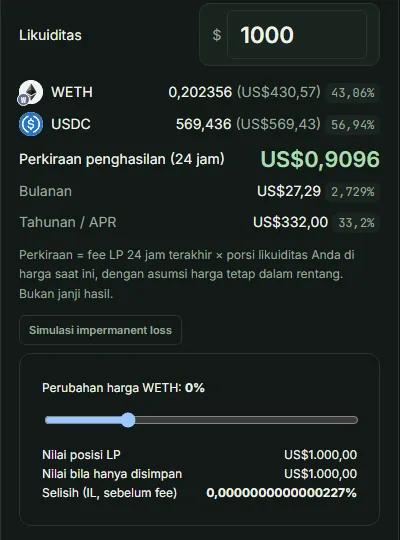
- Subtract impermanent loss — new tokens can drop 90% in a day (IL −42.5%); see impermanent loss explained.
For concentrated liquidity, the pool's Fee APR is an average. A narrow-range position around the active price can earn much more — or nothing if it is out of range.
FAQ
Is liquidity pool APR guaranteed?
No. It is an estimate from the last 24 hours and changes daily.
Why does BaniPool's APR differ from the DEX's website?
Different time windows (24h vs 7d), fee share (total vs LP), or TVL update timing. BaniPool shows the source and time of every number.
What APR is reasonable?
For healthy major pairs, tens of percent per year. Hundreds of percent is usually temporary or high-risk.