Quick answerA liquidity pool is a pair (or set) of tokens locked in a smart contract that acts as the counterparty for swaps on a DEX such as Uniswap, Orca or Raydium. Anyone can become a liquidity provider (LP) by depositing tokens; in return LPs earn a share of every swap fee, with impermanent loss and smart-contract risk as the main risks.
BaniPool data as of November 13, 2026: 58 large pools (TVL ≥ $1M) across 8 networks hold $642.8M in total, with a median fee APR of 34.6%.
Live data from the BaniPool index (pools with TVL ≥ $1M), refreshed every 30 minutes — full DeFi liquidity report
A liquidity pool is a pair of tokens locked in a smart contract that powers swaps on a DEX. Learn how it works, how LPs earn fees, the risks, and real APR data.
A liquidity pool is a pair of tokens locked in a DEX smart contract — Uniswap, Orca, Raydium and others — that traders swap against directly, with no order book and no middleman. People who deposit tokens into the pool are called liquidity providers (LPs), and they earn a share of the fee on every swap. This guide explains how a liquidity pool works, where LP returns come from, the risks, and real numbers from BaniPool's on-chain data.
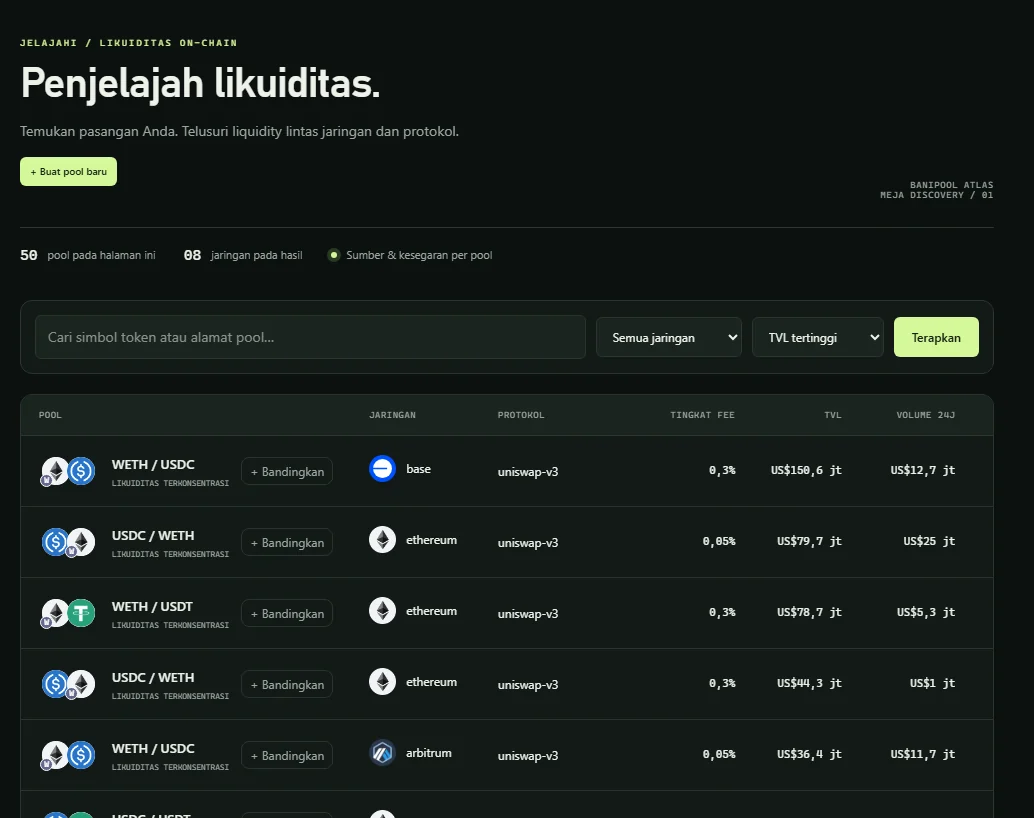
How a liquidity pool works
On a centralized exchange, buyers and sellers are matched through an order book. On a DEX, that role is played by a formula called an AMM (automated market maker):
- LPs deposit two tokens of equal value, for example SOL and USDC.
- A trader buying SOL sends USDC into the pool and takes SOL out.
- Because the pool now holds less SOL and more USDC, the SOL price in the pool rises slightly — that is price impact.
- The trader pays a fee (e.g. 0.05% or 0.3%) that stays in the pool and is shared by all LPs pro rata.
The classic formula is x · y = k (Uniswap v2): the product of both token balances stays constant. Newer designs — concentrated liquidity such as Uniswap v3/v4, Orca Whirlpools and Raydium CLMM — let LPs choose a price range, so capital works harder. See concentrated liquidity vs full-range AMM.
How liquidity providers earn
The main source is swap fees, expressed as an annualized Fee APR:
Fee APR ≈ 24h volume × LP fee × 365 ÷ TVL
Real data from BaniPool's index on November 10, 2026:
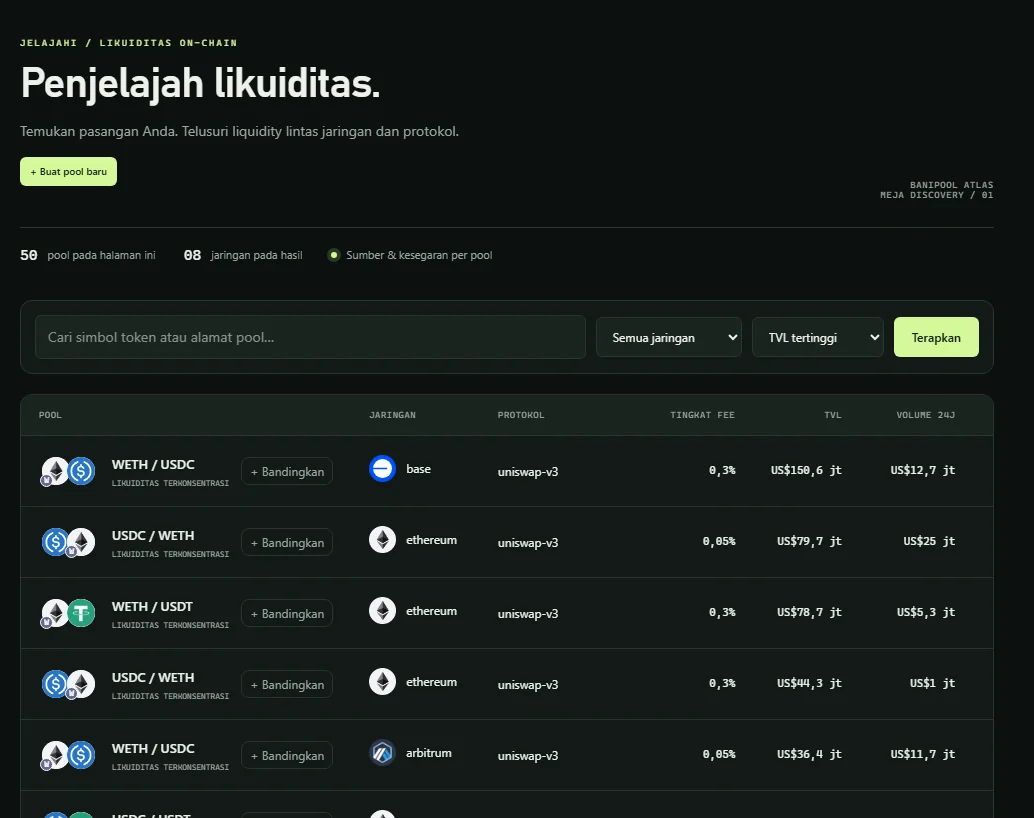
| Pool | Network | Fee | TVL | 24h volume | Fee APR |
|---|
| SOL/USDC (Orca) | Solana | 0.04% | $24.5M | $112.1M | ~68.9% |
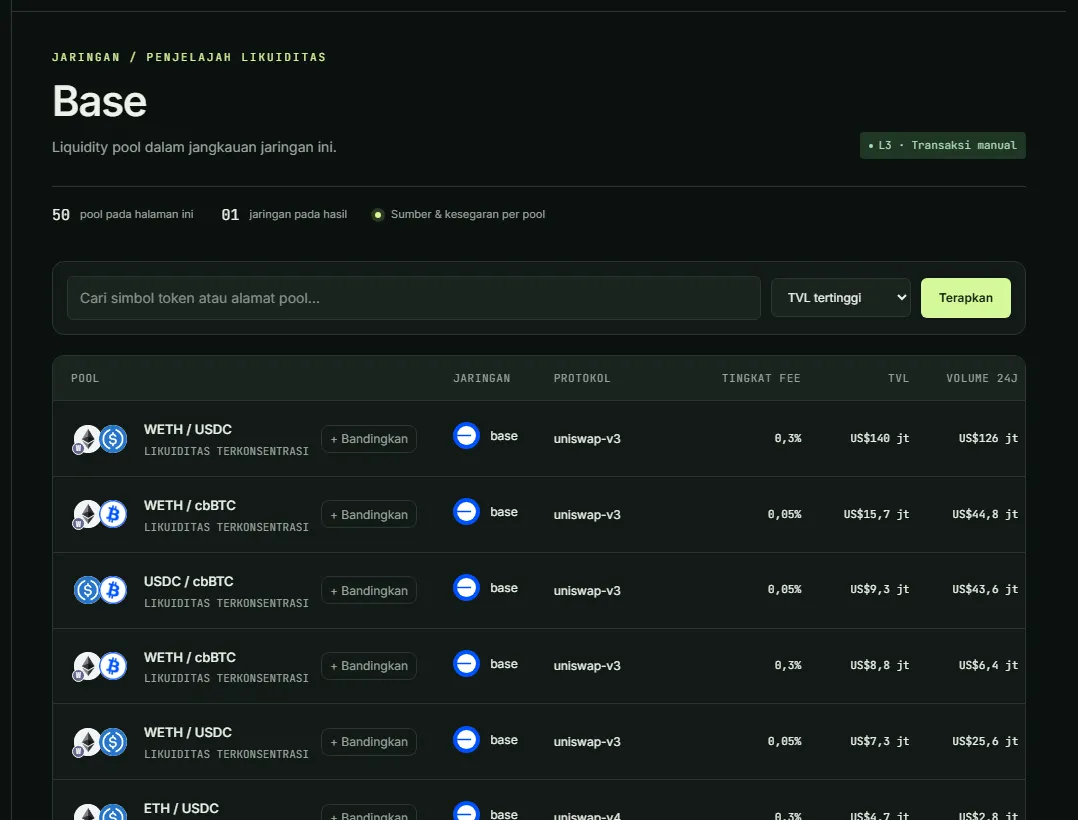
| WETH/USDC (Uniswap v3) | Base | 0.3% | $139.9M | $126.5M | ~82.2% |
| USDC/WETH (Uniswap v3) | Ethereum | 0.05% | $80.4M | $292.4M | ~49.4% |
| USDC/USDT (Uniswap v3) | Ethereum | 0.01% | $33.0M | $16.5M | ~1.4% |
Note the last row: a stablecoin pool barely moves in price, but fees are small. Pools with high volume relative to TVL show high APR — until volume drops.
Some DEXes add reward tokens (e.g. AERO on Aerodrome) when LPs stake their position. That is what people usually call yield farming.
Liquidity pool risks
- Impermanent loss — if one token moves far in price, your position can be worth less than simply holding both tokens. See impermanent loss explained.
- Out of range — concentrated positions stop earning fees when the price leaves your range.
- Scam tokens — honeypots, hidden taxes, rug pulls. Always check a token before adding liquidity.
- Smart contract risk — bugs in the DEX or tools you use.
- Sandwich bots — when you deposit through a swap (Zap), bots can move the price. Read what is a sandwich attack.
How to start as a liquidity provider
- Set up a wallet (MetaMask, Rabby, Phantom) and keep a little native token for gas.
- Open the BaniPool liquidity pool explorer and pick a pool with large TVL, steady volume and an A–B security grade.
- Deposit both tokens, or use Zap In to deposit with a single token.
- Track fees, PnL and range status in your Profile.
Step-by-step guides per network: Solana, BNB Chain, Base, Ethereum.
FAQ
Is a liquidity pool the same as staking?
No. Staking locks one token to secure a network or protocol. A liquidity pool holds two tokens used for swaps; returns come from trader fees and carry impermanent loss risk.
What is the minimum to become an LP?
Protocols have no minimum. Gas is what matters: on Ethereum small amounts can be eaten by gas, while on Base, Arbitrum, BNB Chain or Solana a few dozen dollars is reasonable.
Is Fee APR guaranteed?
No. It is an estimate from recent volume and TVL. Volume can drop, and impermanent loss can exceed fees.
What is an LP token?
Proof of your share of the pool. On Uniswap v2, Raydium CPMM and PumpSwap it is a token; on Uniswap v3/v4 and Orca it is a position NFT.