Quick answerAdding Uniswap liquidity on Ethereum mainnet makes the most sense for larger capital, because one transaction can cost several to tens of dollars in gas, which your fees must cover. Choose the fee tier by pair (0.01–0.05% for stablecoins, 0.3% for common pairs such as ETH/USDC) and send the transaction through a private RPC such as Flashbots Protect to avoid sandwich attacks.
BaniPool data as of November 13, 2026: Ethereum has 15 pools with TVL ≥ $1M ($321.6M in total); the largest is USDC/WETH (Uniswap v3) ($79.1M).
Live data from the BaniPool index (pools with TVL ≥ $1M), refreshed every 30 minutes — full DeFi liquidity report
Add liquidity on Uniswap on Ethereum mainnet: check whether fees beat gas, choose a fee tier, top pool APR data, and protect transactions with Flashbots Protect.
How to add liquidity on Uniswap on Ethereum is the same as on any network — what differs is gas. Ethereum mainnet has the deepest DeFi liquidity, but every action (deposit, claim, re-range, withdraw) can cost several dollars. This guide helps you work out whether adding liquidity on Ethereum makes sense for your capital, choose a fee tier, read the top pools, and protect transactions from sandwiches with Flashbots Protect or MEV Blocker.
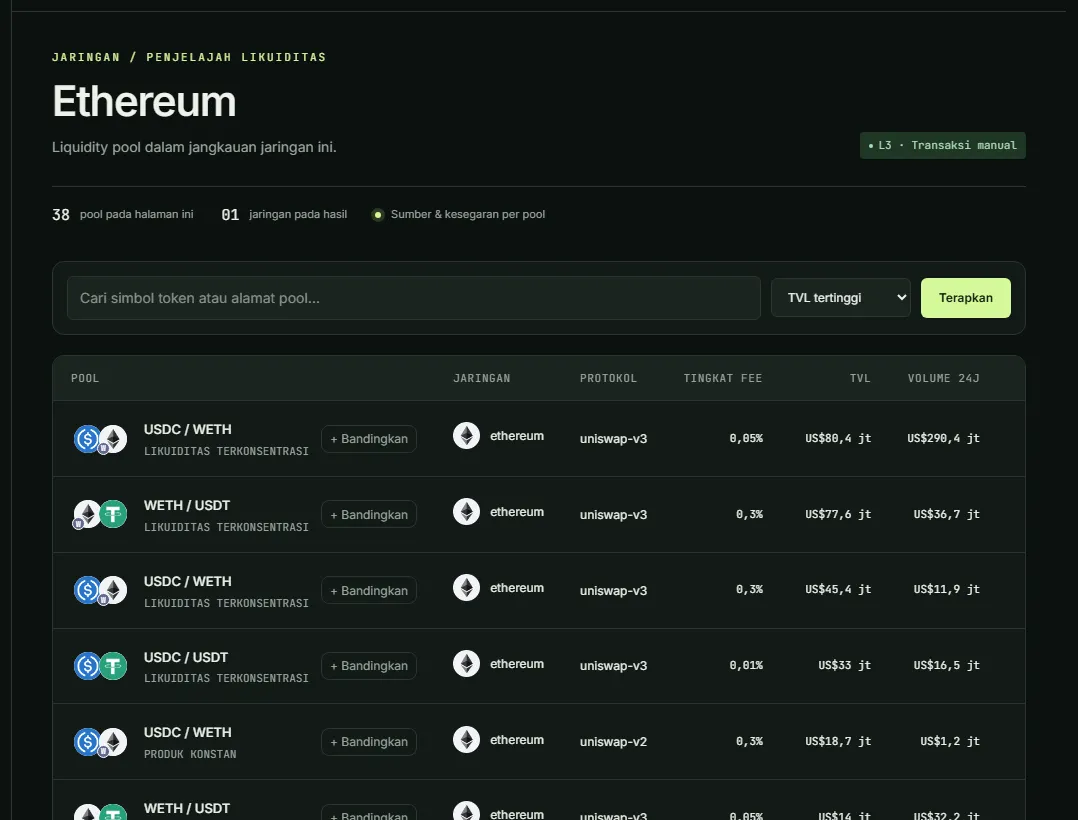
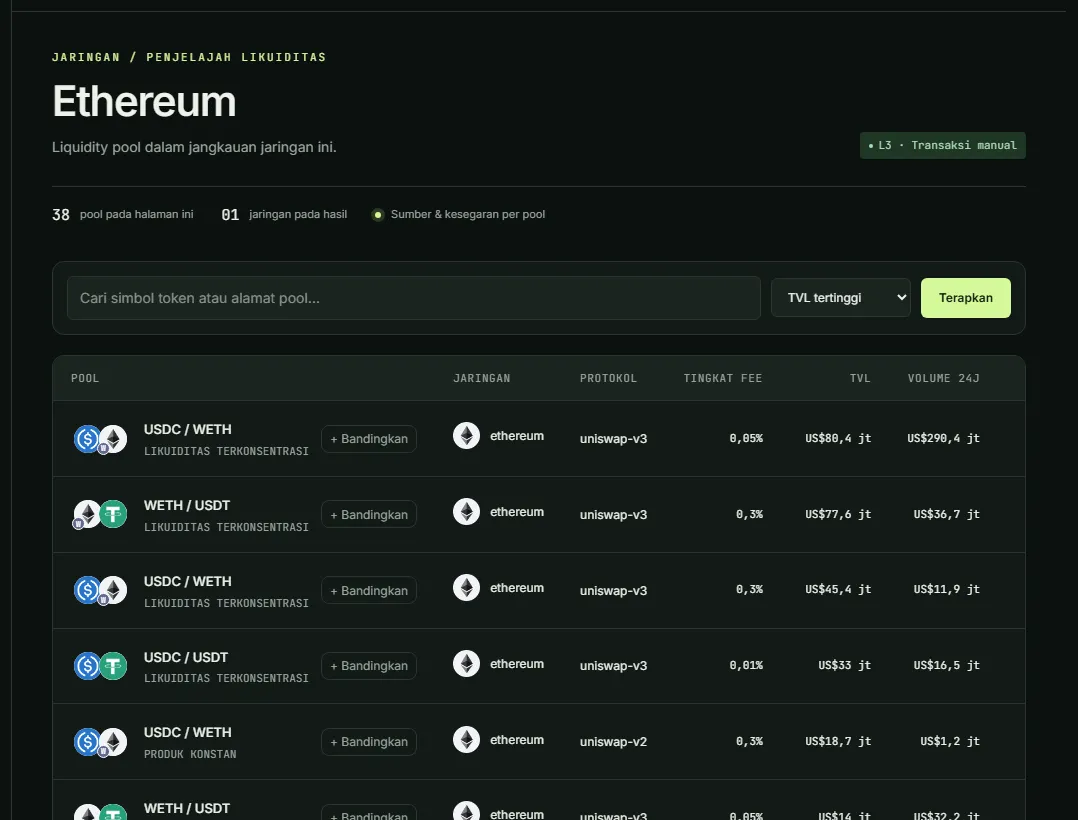
Top Ethereum pools (BaniPool data, November 10, 2026)
| Pool | Version | Fee | TVL | 24h volume | Fee APR |
|---|
| USDC/WETH | Uniswap v3 | 0.05% | $80.4M | $292.4M | ~49.4% |
| WETH/USDT | Uniswap v3 | 0.3% | $77.5M | $37.0M | ~43.0% |
| USDC/WETH | Uniswap v3 | 0.3% | $45.4M | $12.0M | ~24.4% |
| USDC/USDT | Uniswap v3 | 0.01% | $33.0M | $16.5M | ~1.4% |
Is it worth it for your capital?
Do a quick calculation before depositing:
- Monthly fees ≈ capital × Fee APR ÷ 12
- Gas ≈ deposit + claim + withdraw (at least 3 transactions) + every rebalance
Example: $1,000 in a 40% APR pool earns about $33/month. If three transactions cost $15, about $18 remains — before impermanent loss. For small capital, the same pair on Base or Arbitrum is usually more efficient.
Choosing a Uniswap fee tier
- 0.01% — stablecoin/stablecoin (USDC/USDT).
- 0.05% — highly liquid major pairs (ETH/USDC).
- 0.3% — typical pairs.
- 1% — small or volatile tokens.
- Uniswap v4 — custom fees and hooks; BaniPool flags risky hooks.
On Ethereum, a wider range with the right fee tier usually beats a narrow range that needs frequent maintenance.
Steps to add liquidity on Ethereum
- Open Ethereum pools, sort by TVL or Fee APR.
- Check the security grade and 24h volume.
- Choose Zap In (one token, including ETH) or Add liquidity.
- Set the range and amount — BaniPool shows estimated gas in dollars.
- Approve the token (exact amount) and the deposit transaction.
Protect transactions: Flashbots Protect & MEV Blocker
Ethereum has a public mempool. In the transaction dialog, press ⚙ → Private mempool (RPC):
- Flashbots Protect —
https://rpc.flashbots.net/fast - MEV Blocker —
https://rpc.mevblocker.io
MetaMask rejects automatic setup for Ethereum Mainnet, so copy the URL and add it manually: Settings → Networks → Ethereum → add RPC → make it the default. BaniPool's automation keeper on Ethereum already uses both automatically. Details: what is a sandwich attack.
FAQ
What is the minimum to add liquidity on Ethereum?
There is no protocol minimum, but because of gas, capital below a few thousand dollars is often more efficient on an L2.
Uniswap v3 or v4 on Ethereum?
v3 has the deepest liquidity for major pairs. v4 saves gas on some actions, supports native ETH and custom fees.
Why is the USDC/USDT pool APR so low?
A 0.01% fee and volume that is small relative to TVL. The upside: almost no impermanent loss.