Quick answerArbitrum One and OP Mainnet are Ethereum layer 2s where gas costs a few cents, so adding Uniswap liquidity there is far cheaper than on Ethereum mainnet. Both use a sequencer to order transactions, which makes sandwich attacks much rarer than in a public mempool; the most liquid pair is usually ETH/USDC.
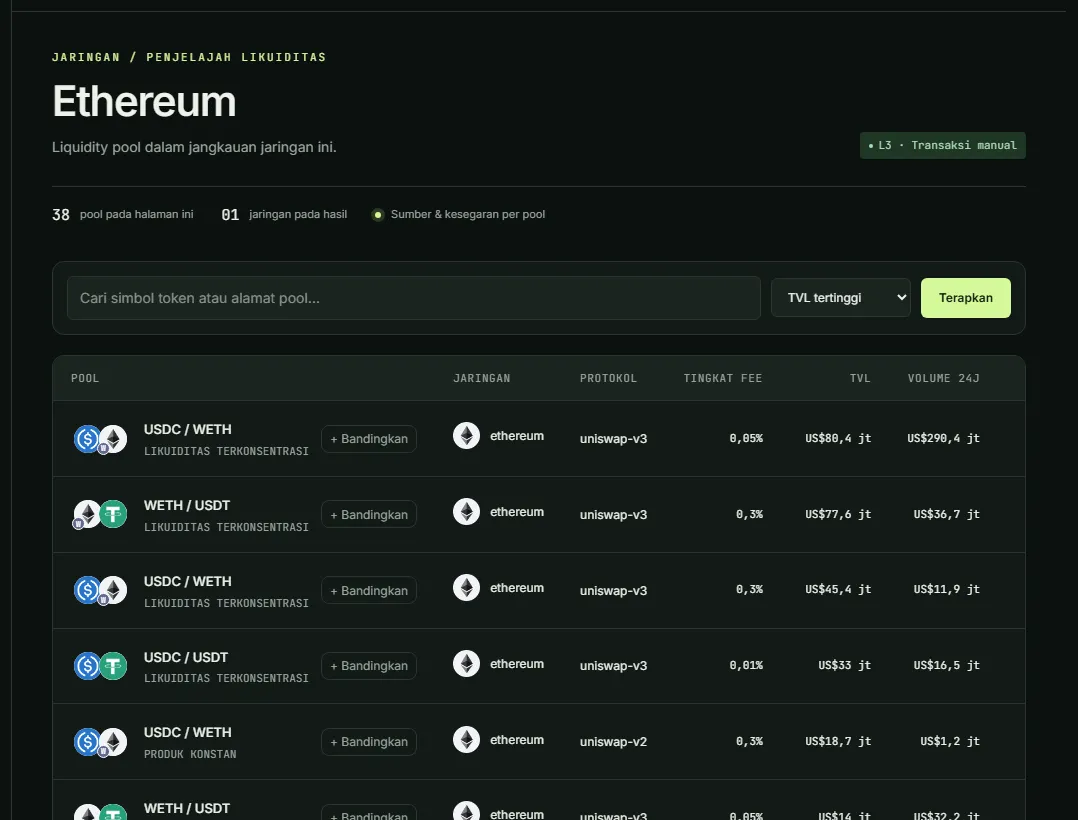
BaniPool data as of November 13, 2026: the largest pool on Arbitrum is WETH/USDC (Uniswap v3) with $29.5M TVL.
Live data from the BaniPool index (pools with TVL ≥ $1M), refreshed every 30 minutes — full DeFi liquidity report
Add liquidity on Uniswap on Arbitrum One and OP Mainnet: how the two L2s differ, ETH/USDC pool APR data, gas of a few cents, and why sandwiches are rare there.
How to add liquidity on Arbitrum and Optimism is the middle ground between Ethereum's deep liquidity and cheap gas. Arbitrum One and OP Mainnet are the two oldest Ethereum L2s with large DeFi ecosystems, gas of a few cents, and no public mempool. BaniPool supports Uniswap v2, v3 and v4 pools on both. This guide compares the networks, shows the top pools, and walks through adding liquidity.
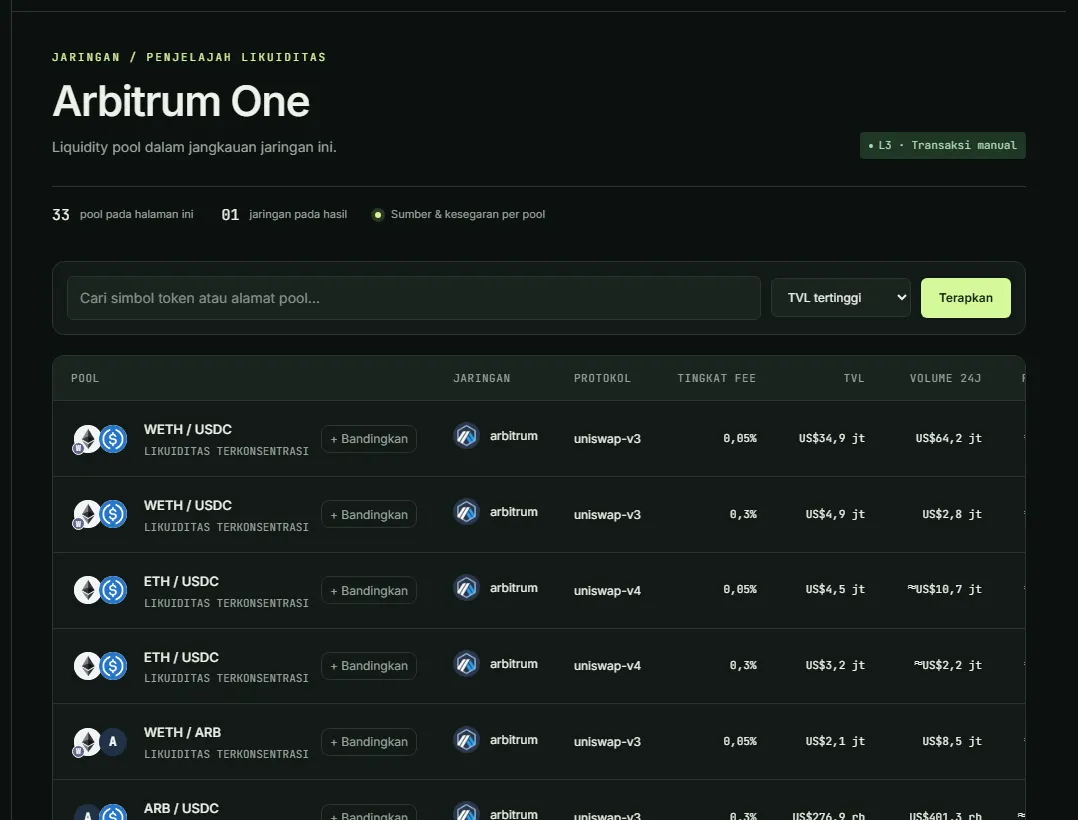
Top pools (BaniPool data, November 10, 2026)
Arbitrum One
| Pool | Version | Fee | TVL | 24h volume | Fee APR |
|---|
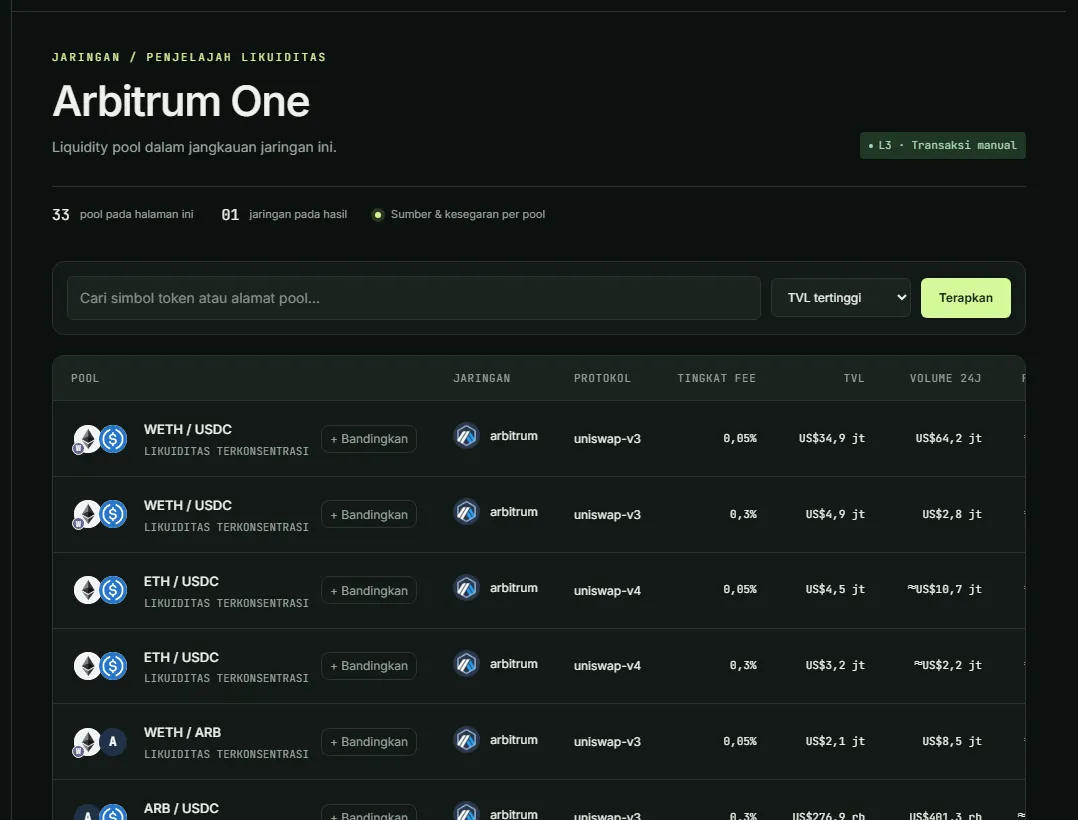
| WETH/USDC | Uniswap v3 | 0.05% | $34.9M | $64.6M | ~26.8% |
| WETH/USDC | Uniswap v3 | 0.3% | $4.9M | $2.8M | ~52.9% |
| ETH/USDC | Uniswap v4 | 0.05% | $4.5M | $10.7M | ~43.3% |
| ETH/USDC | Uniswap v4 | 0.3% | $3.2M | $2.2M | ~76.2% |
OP Mainnet
| Pool | Version | Fee | TVL | 24h volume | Fee APR |
|---|
| USDC/WETH | Uniswap v3 | 0.3% | $4.4M | $3.8M | ~80.0% |
| USDC/WETH | Uniswap v3 | 0.05% | $0.27M | $0.5M | ~25.9% |
| WETH/OP | Uniswap v3 | 0.3% | $0.23M | $0.09M | ~36.4% |
Notably, on Arbitrum the Uniswap v4 ETH/USDC pools show higher APRs than v3 at the same fee — because v4 TVL is still smaller.
Arbitrum vs OP Mainnet
- Arbitrum One — an optimistic rollup by Offchain Labs. The sequencer orders transactions by arrival time, with an auctioned Timeboost express lane.
- OP Mainnet — built on the OP Stack (same as Base). The sequencer orders by priority fee.
Both use ETH for gas.
Steps to add liquidity
- Set up a wallet (MetaMask, Rabby, Coinbase Wallet) and ETH on Arbitrum or OP. Move funds with the BaniPool bridge.
- Open Arbitrum pools or OP Mainnet pools.
- Compare fee tiers and versions for the same pair with + Compare.
- Choose Zap In or Add liquidity, set a range, and sign.
- Cheap gas makes narrower, frequently adjusted ranges realistic — or hand it to automated rebalancing.
Private mempool?
Not needed. Arbitrum and OP Mainnet have no public mempool — transactions go straight to the sequencer.
Creating a pool
Create a pool on Arbitrum or on OP Mainnet: the Uniswap pool is created and seeded in one transaction.
FAQ
Arbitrum or Optimism — which is better for LPs?
Arbitrum has far more volume and TVL on major pairs. OP Mainnet is smaller, so some pools show higher APRs but with thinner liquidity.
How long does withdrawing from Arbitrum to Ethereum take?
About 7 days via the native bridge. Fast bridges like Across (used by BaniPool) finish in minutes for a small fee.
Do I need a private RPC on Arbitrum?
No. Without a public mempool, classic sandwiches are very hard.