Meteora DLMM (Dynamic Liquidity Market Maker) is a Solana DEX that splits liquidity into discrete price bins with dynamic fees that rise when volatility is high. There are three ways to spread liquidity: Spot (even across all bins — the most versatile for beginners), Curve (concentrated around the current price — for stable pairs) and Bid-Ask (heavier at both ends of the range — to capture large price swings). Each new position needs about 0.042 SOL of account rent.
← All articles · Baca dalam Bahasa Indonesia
Meteora DLMM Strategy: Spot, Curve or Bid-Ask for Beginners
November 11, 2026
Meteora DLMM strategies explained: Spot, Curve and Bid-Ask, one-sided deposits, bin step, number of bins, dynamic fees and the ~0.042 SOL position rent — with picks per market.
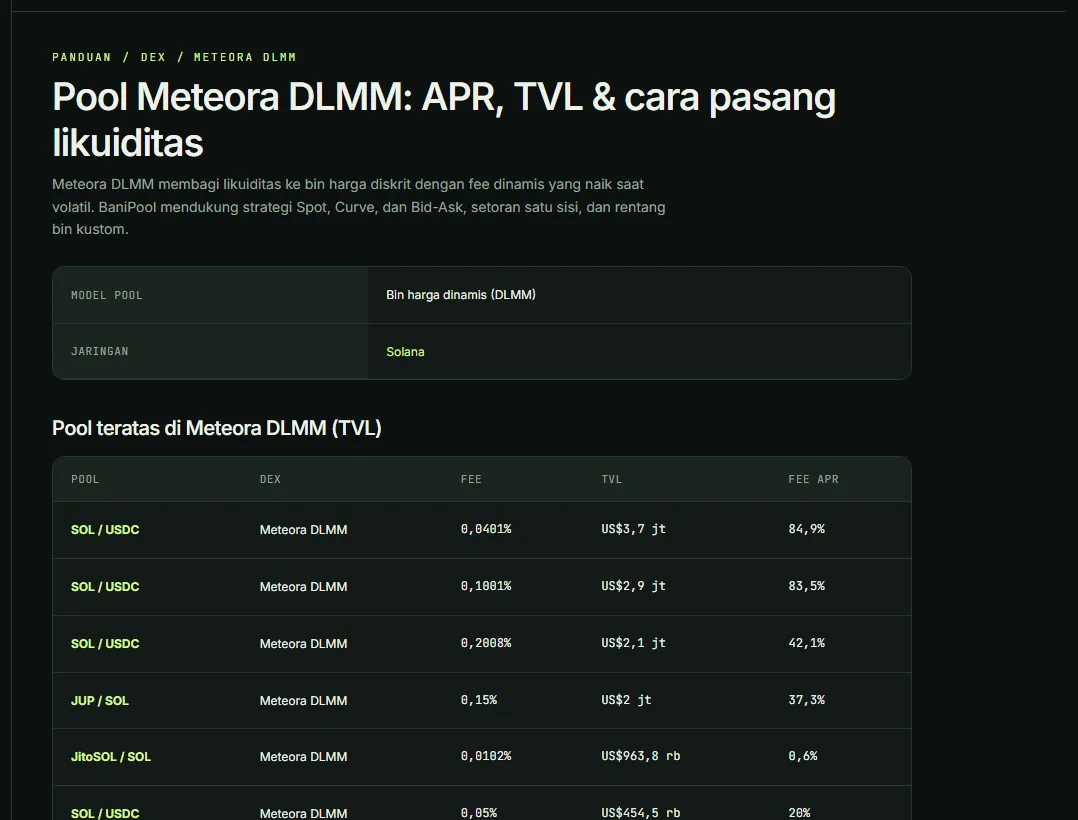
A Meteora DLMM strategy decides how your liquidity is spread across price bins: evenly (Spot), concentrated in the middle (Curve), or concentrated at the edges (Bid-Ask). Meteora DLMM (Dynamic Liquidity Market Maker) is a Solana DEX that splits liquidity into discrete bins with dynamic fees — fees rise when the market is volatile, so LPs are paid more exactly when risk is highest. This guide explains the three strategies, one-sided deposits, choosing bins, and account rent.
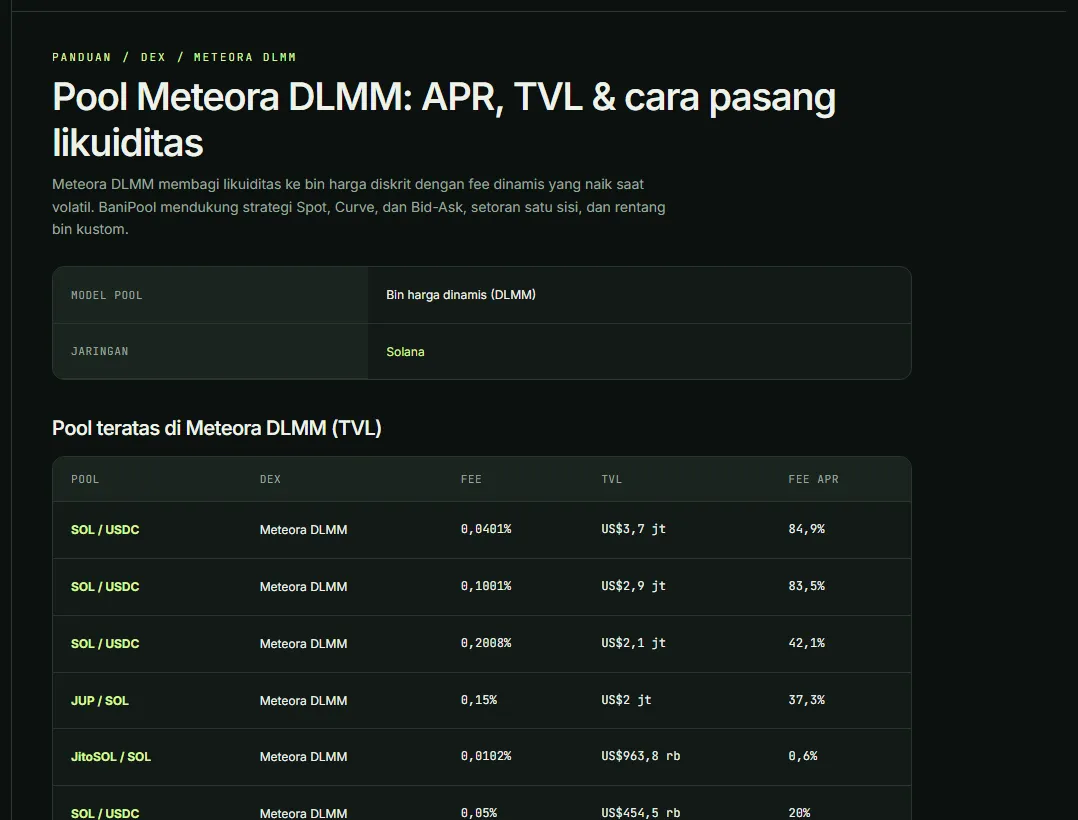
How bins work in Meteora DLMM
Each bin holds one price. Swaps consume liquidity bin by bin; the bin in use is the active bin. The price gap between bins is set by the pool's bin step — for example, bin step 10 means 0.1% per bin. Fees are a base fee plus a dynamic fee that rises with volatility.
The three DLMM strategies
| Strategy | Distribution | Best for | Risk |
|---|---|---|---|
| Spot | Even across all bins | Beginners, unclear market direction | Medium |
| Curve | Concentrated around the price | Stablecoins, LSTs (SOL/JitoSOL), sideways markets | High IL if price moves far |
| Bid-Ask | Concentrated at range edges | Volatile markets, DCA buying dips / selling rips | Needs monitoring |
Spot is simplest and earns fees across the whole range. Curve earns the most per dollar while the price stays near the center. Bid-Ask captures big moves and, when one-sided, works like a laddered order.
One-sided deposits
In DLMM you can deposit just one token:
- only the base token (e.g. a meme token) → bins above the current price; tokens sell gradually as the price rises;
- only the quote token (SOL or USDC) → bins below the price; you buy gradually as the price falls.
A popular combo: one-sided Bid-Ask with SOL below the price to "DCA in" to a token you believe in.
Choosing bins and range
- One DLMM position on BaniPool covers up to 69 bins.
- A larger bin step = a wider range with the same number of bins.
- BaniPool offers quick ranges and custom ranges (lower/upper bin) with estimated prices at each edge.
- Narrow range + Curve = maximum fees, but quickly out of range.
DLMM position rent
Each DLMM position opens a Solana account with ~0.042 SOL rent, refunded when the position is closed. If your range touches a bin array that has never been created, there is extra rent that is not refunded. BaniPool shows both before you deposit.
How to open a DLMM position on BaniPool
- Open a Meteora DLMM pool from the Solana explorer or the Meteora DLMM page.
- Choose a strategy and bin range.
- Enter amounts — two tokens, one side, or Zap In with a single token.
- Turn on Private mempool (Jito) in ⚙ — see Solana private mempool.
- Sign, then track the active bin, collected fees and PnL in your Profile.
FAQ
Which Meteora DLMM strategy is best for beginners?
Spot with a moderate range. Once you understand how your pair moves, try Curve (stable pairs) or Bid-Ask (volatile pairs).
Why is my DLMM position not earning fees?
The price left all of your position's bins. The position now holds one token; wait for the price to return or move the range.
Is the 0.042 SOL rent lost?
No. Position account rent is refunded when the position is closed.
What is bin step?
The price gap between bins in basis points. Bin step 10 = 0.1% per bin; bin step 100 = 1% per bin.