Quick answerTo choose the best liquidity pool, weigh six indicators together rather than APR alone: TVL, volume/TVL ratio, fee tier, fee APR, pool age and the token safety score. Good pools usually have enough TVL, healthy daily volume relative to TVL and tokens that pass safety checks; a very high APR on a small or new pool is often temporary.
| Indicator | Good sign |
|---|
| TVL | Large enough to resist manipulation |
| Volume/TVL | High daily volume relative to TVL |
| Fee APR | Stable from day to day |
| Safety | Tokens graded A–B |
BaniPool data as of November 13, 2026: the median volume/TVL ratio of large pools (TVL ≥ $1M) is 0.89×, with a median fee APR of 34.7%.
Live data from the BaniPool index (pools with TVL ≥ $1M), refreshed every 30 minutes — full DeFi liquidity report
Choose the best liquidity pool with 6 checks: TVL, volume/TVL ratio, fee tier, Fee APR, pool age and security grade — plus how to compare pools side by side on BaniPool.
How to choose the best liquidity pool is not about finding the highest APR. High APR often comes from tiny pools a few hours old — and ends in a rug pull. This guide gives you 6 checks you can run in two minutes, real examples from BaniPool data, and how to compare pools side by side before adding liquidity.
6 checks for choosing a liquidity pool
1. TVL (total value locked)
Total liquidity in the pool. Large TVL means small price impact and more resistance to manipulation. Beginners should start with pools above $1 million TVL.
2. Volume / TVL ratio
Fees come from volume. A pool whose 24h volume exceeds its TVL earns high fees per dollar. Example from BaniPool data (November 10, 2026): WETH/USDG 0.01% on Robinhood Chain — $246M volume on $13.8M TVL (~18×).
3. Fee tier
0.01% for stablecoins, 0.05% for major pairs, 0.3% for typical pairs, 1% for volatile tokens. The lowest tier does not always earn the least — on BNB Chain, USDT/WBNB 0.01% showed ~30.6% APR, higher than the 0.05% tier (~19.4%).
4. Fee APR
Annualized estimate: 24h volume × LP fee × 365 ÷ TVL. Read liquidity pool APR explained so a 5,000% APR does not fool you.
5. Pool age and volume stability
Look at 7-day history analytics. Steady volume is more reliable than a one-day spike.
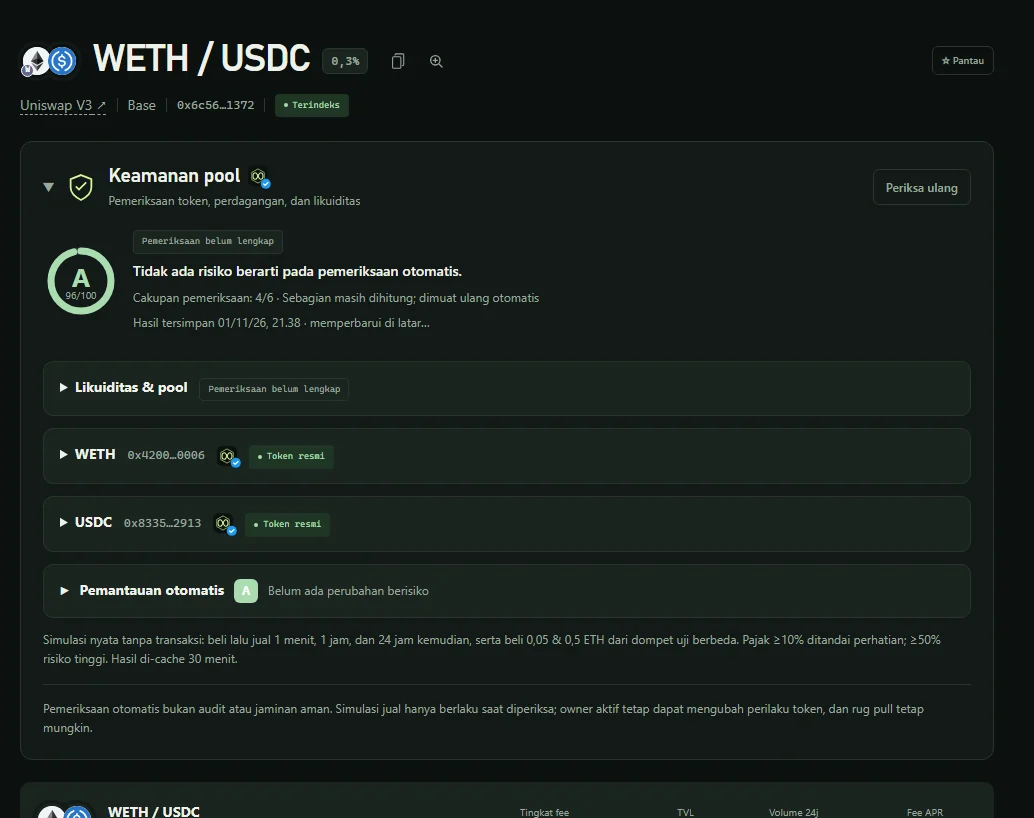
6. Security grade A–F
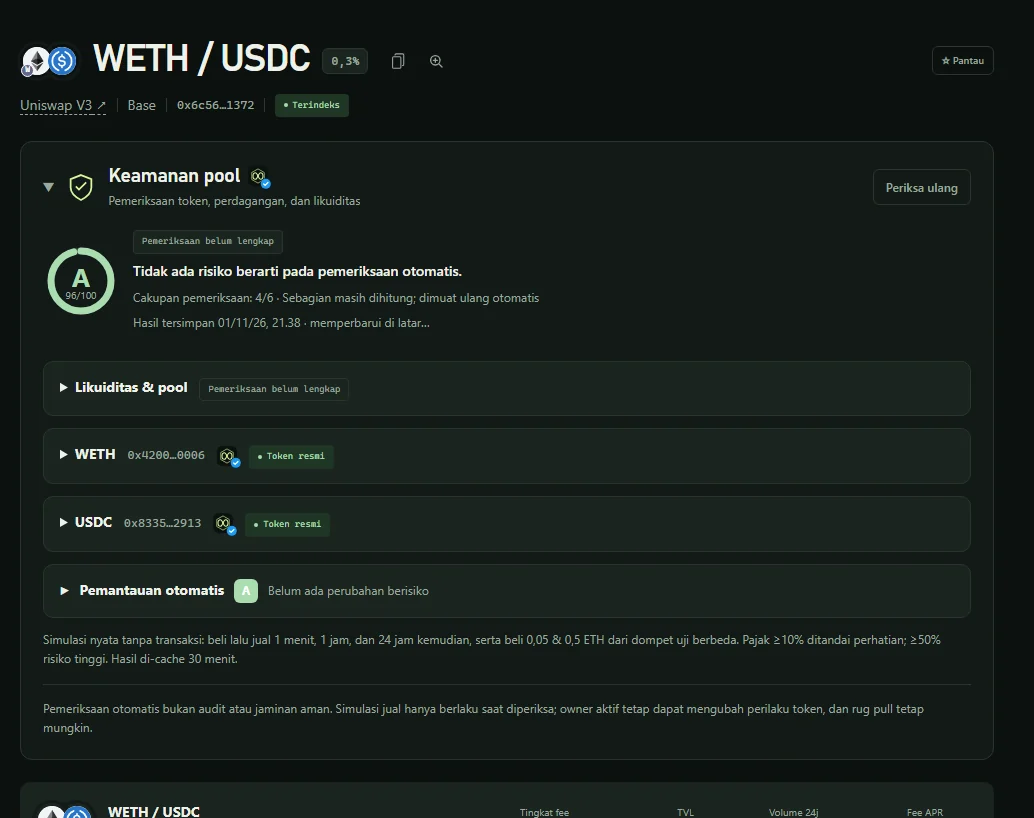
BaniPool checks token contracts, sell simulation, large holders and withdrawable liquidity. Avoid D–F. Details: how to check scam tokens.
How to pick a pool on BaniPool
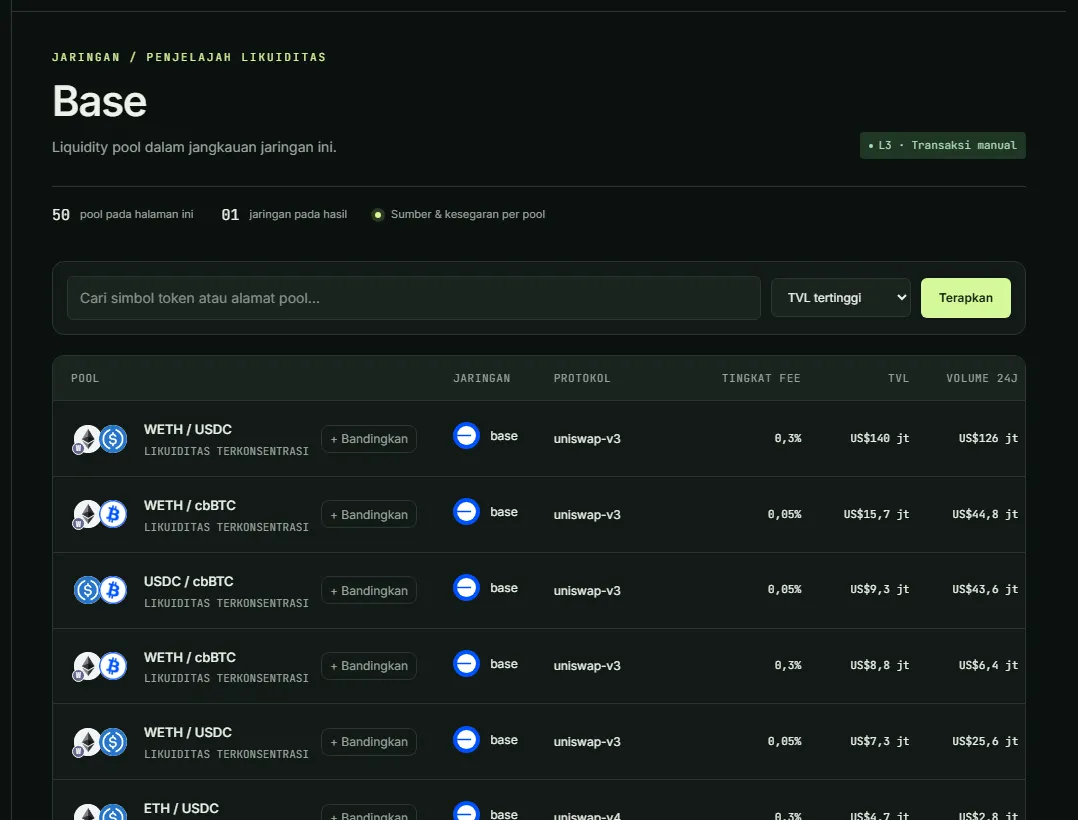
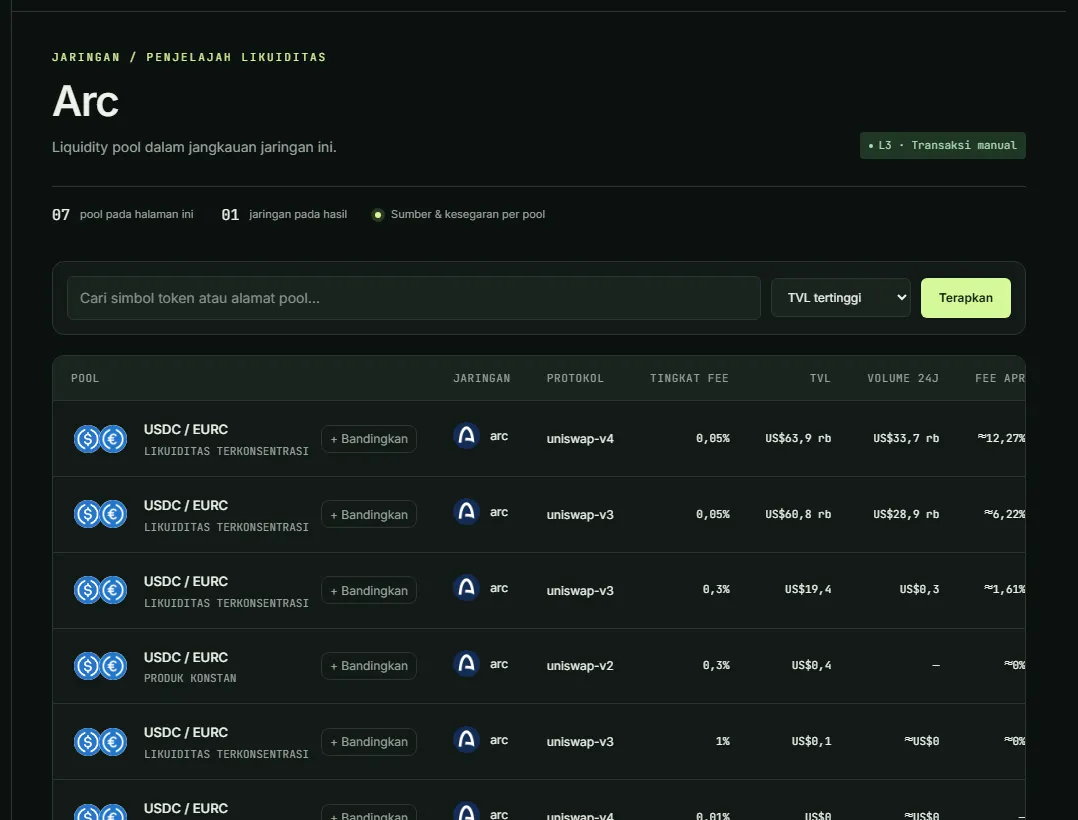
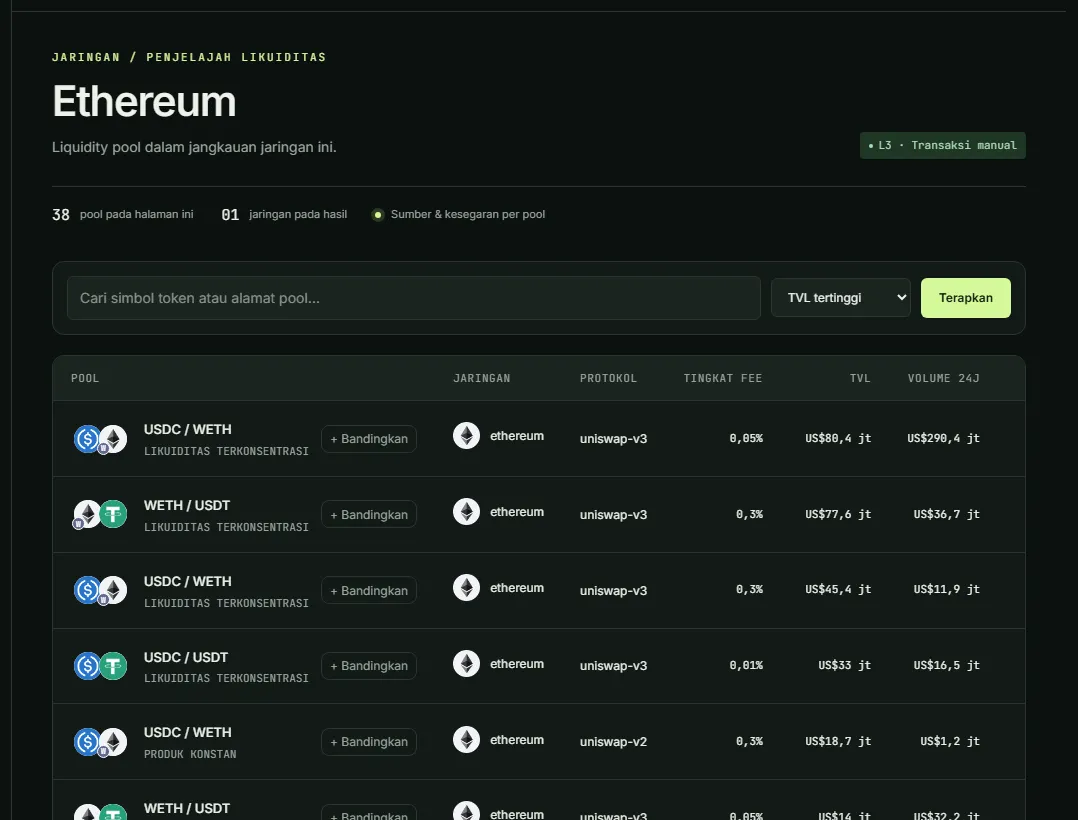
- Open the liquidity pool explorer — filter by Network and Platform (DEX), or search a token or pool address.
- Sort by Highest TVL or Fee APR.
- Press + Compare on 2–5 pools for the same pair — TVL, volume, fee and APR appear side by side over the same observation window.
- Open the pool: Pool security, Fee simulator, Range backtest, Liquidity distribution, 7-day analytics and Data sources.
- Press ☆ Watch to save the pool to your watchlist.
Pools that are not indexed yet can still be opened by address (or Uniswap v4 pool ID).
Red flags
- Hundreds of percent APR on a pool hours old with small TVL.
- Security grade D–F or a ⛔ Scam badge.
- High volume but few transactions (likely bot volume).
- A few holders controlling most of the token supply.
FAQ
Which liquidity pool is safest for beginners?
Stablecoin pairs (USDC/USDT) or major pairs (ETH/USDC, SOL/USDC) with large TVL on a low-gas network.
Does high APR mean a good pool?
Not necessarily. Check TVL, pool age, volume stability and the security grade.
How do I compare the same pair across DEXes?
Use + Compare in the BaniPool explorer, e.g. SOL/USDC on Orca vs Raydium.