When creating a liquidity pool, pick the fee tier by the pair's volatility: 0.01% for stablecoin pairs, 0.05% for large, stable pairs, 0.3% for common pairs and 1% for new or highly volatile tokens. The initial price must match the market price, because a wrong price is immediately exploited by arbitrage bots; a narrow price range earns more fees but goes out of range sooner.
← All articles · Baca dalam Bahasa Indonesia
How to Choose a Fee Tier, Initial Price & Range When Creating a Pool
November 11, 2026
Choose the right fee tier (0.01%–1%), initial price and price range when creating a liquidity pool, using Fee Advisor: captured volume, IL/LVR cost and net APR.
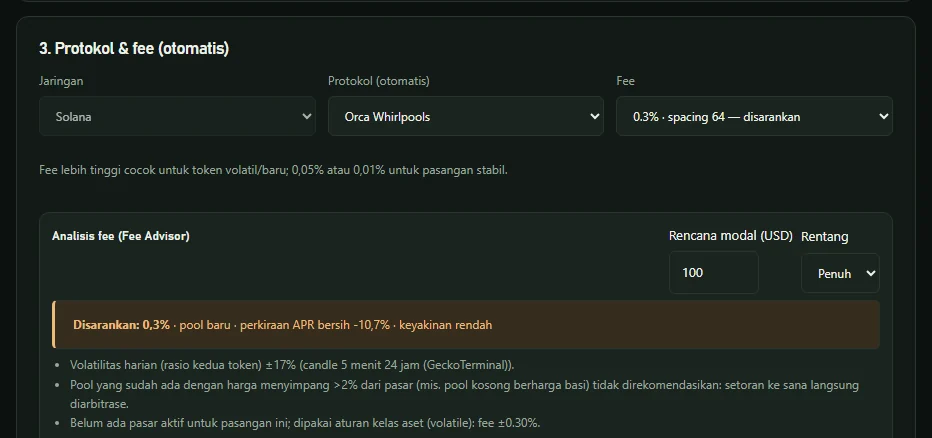
How to choose a fee tier, initial price and range decides whether the pool you create gets volume — and whether your first deposit is drained by arbitrage bots. These three decisions apply to Uniswap (EVM) and Orca/Raydium (Solana). This article explains the rules of thumb and how to read BaniPool's Fee Advisor.
1. Choosing a fee tier
| Pair type | Typical fee tier | Why |
|---|---|---|
| Stablecoin / stablecoin | 0.01% | Price barely moves; high volume with thin spreads |
| Major pairs (ETH/USDC, SOL/USDC) | 0.04%–0.05% | Tight competition between pools |
| Typical pairs | 0.3% | Balance between volume and fee |
| New / volatile tokens | 1% or more | Compensates for large impermanent loss |
Remember: routers pick the pool with the best price after fees. A fee much higher than competing pools can leave your pool without volume.
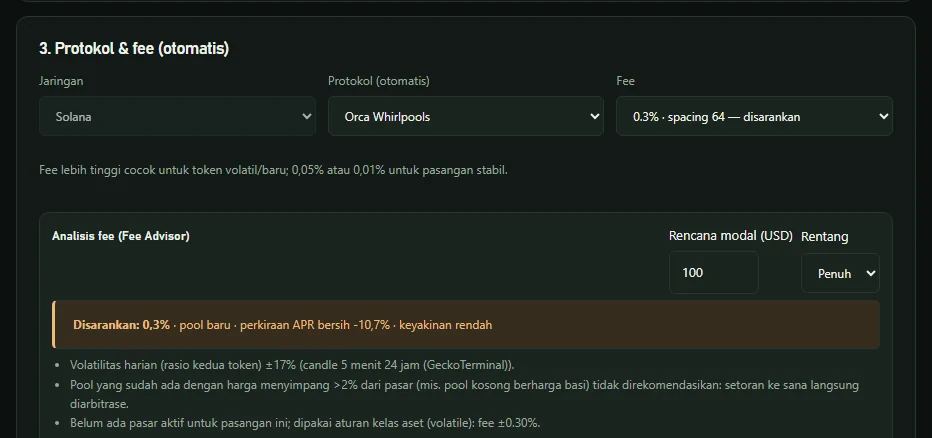
Reading Fee Advisor
The Fee analysis (Fee Advisor) panel appears at the Protocol & fee step. Enter your Planned capital (USD) and Range, then look at:
- Recommended ★ — the tier with the best estimated net APR and its confidence;
- Captured volume/day — estimated volume that will route through your pool;
- IL/LVR cost — estimated loss from impermanent loss and arbitrage;
- Net APR = fee APR − IL/LVR cost;
- Competing pools — liquidity and volume of other pools for the same pair.
If every tier is expected to lose money, consider a wider range, smaller capital, or not providing liquidity.
2. Setting the initial price
The initial price sets the value of both tokens in the new pool. If it is far from the market, arbitrage bots immediately take the difference out of your deposit.
- Click Use market price — BaniPool uses existing pool rates, a Jupiter quote (Solana) or BaniPool USD prices.
- Watch the deviation number; a price different from the market must be confirmed deliberately.
- For brand-new tokens with no reference price, double-check token order and decimals before entering a price.
- Deposits into a new pool carry your initial price; the transaction is cancelled if bots already moved the pool price.
3. Choosing a price range
- Full range — active at every price; simplest and recommended for new pools.
- Wide / narrow — more fees per dollar, but no fees once out of range and larger impermanent loss.
- If the initial price is outside your range, the position holds a single token and earns nothing until the price enters the range.
To understand the trade-off, read concentrated liquidity vs full-range AMM and impermanent loss explained.
4. Zap In or Manual
- Zap In — one token is enough; there is price impact and slippage; check the breakdown.
- Manual — you already hold both tokens; no swap and no platform fee.
FAQ
Which fee tier is most profitable?
The one that captures the most volume relative to its impermanent loss. Fee Advisor computes net APR per tier for your pair.
Can I change the fee tier after creating a pool?
Not on Uniswap v3 or Orca — create a new pool with another fee. Uniswap v4 pools with dynamic-fee hooks can differ.
What is LVR?
Loss-versus-rebalancing: the LP's loss from arbitrage repricing the pool to the market. Together with impermanent loss, it is the main cost of providing liquidity.
Related articles
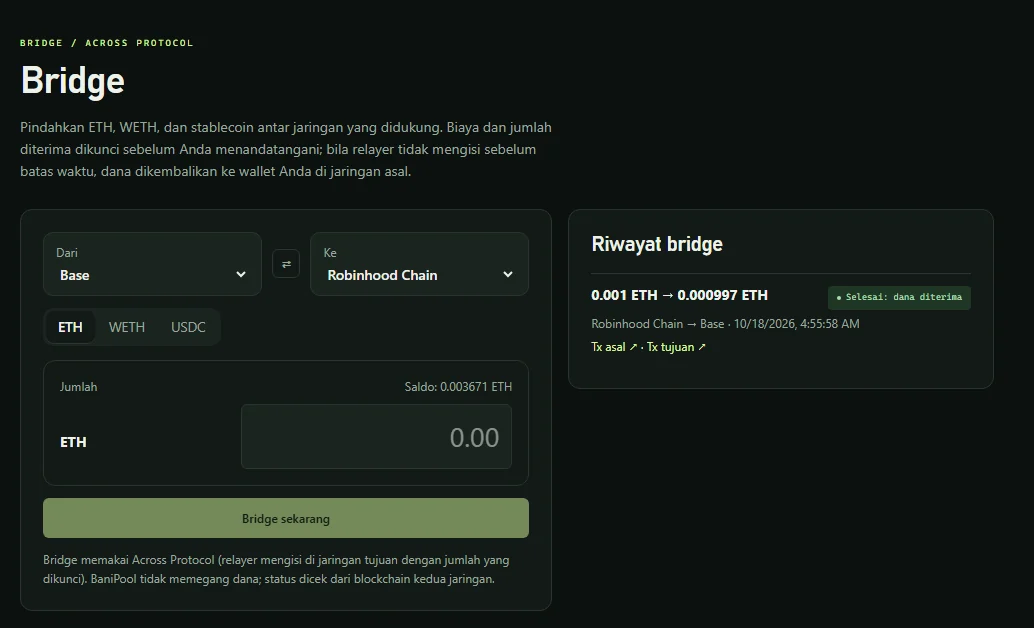
How to Bridge ETH & USDC Between Networks + Earn on Stablecoin Vaults
Bridge ETH, WETH and USDC between networks (Base, Arbitrum, Robinhood Chain, Ethereum and more) via Across, plus how to deposit stablecoins into Spark yield vaults.
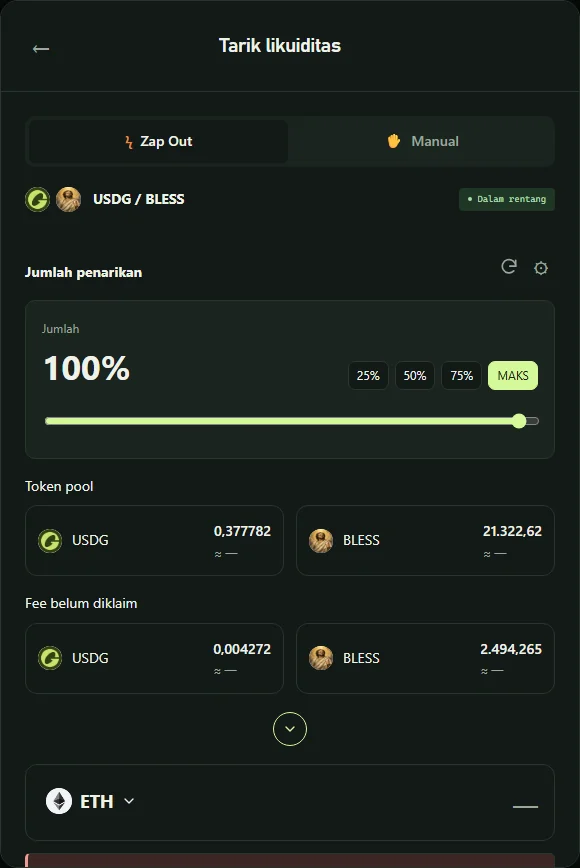
How to Claim LP Fees, Compound & Remove Liquidity (Zap Out to 1 Token)
Claim liquidity provider fees, compound them back into the position, add liquidity, and remove liquidity partially or fully — including Zap Out to a single token like USDC or SOL.
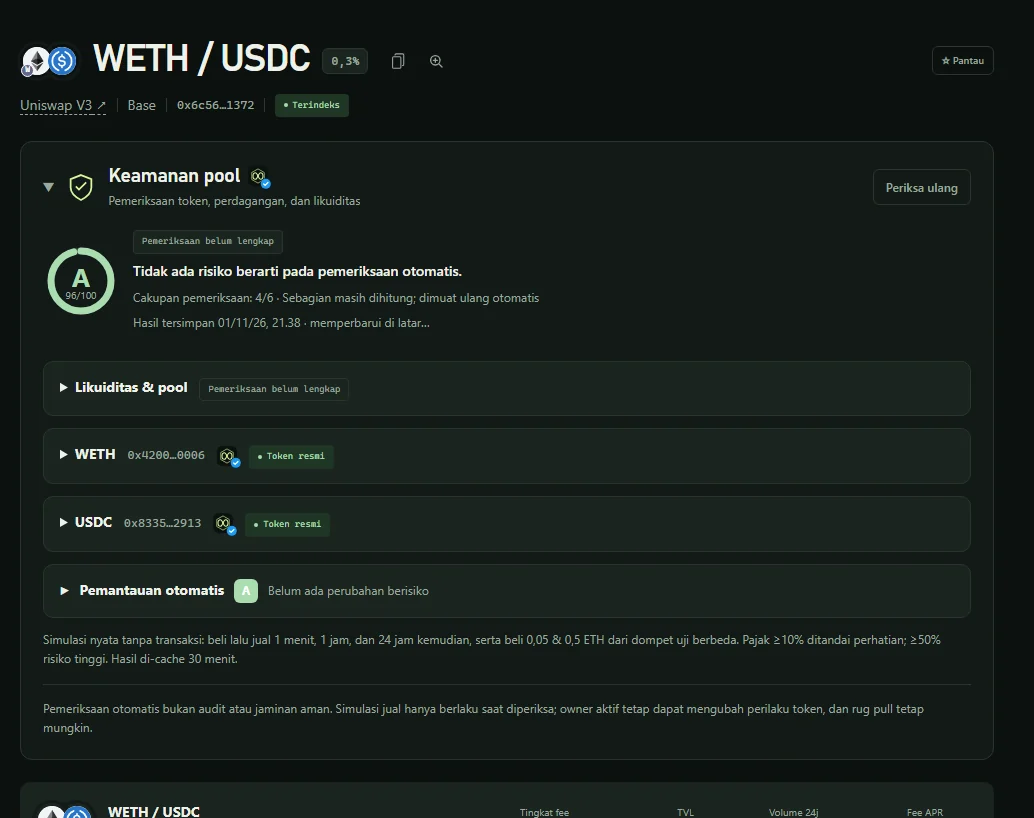
How to Choose the Best Liquidity Pool: TVL, Volume, APR & Safety
Choose the best liquidity pool with 6 checks: TVL, volume/TVL ratio, fee tier, Fee APR, pool age and security grade — plus how to compare pools side by side on BaniPool.