Quick answerBaniPool is a non-custodial, multichain DeFi liquidity dashboard: explore pools on 10 networks (Ethereum, Base, BNB Chain, Arbitrum, OP Mainnet, Polygon, Avalanche, Robinhood Chain, Arc, Solana), add liquidity, create pools, swap and track LP positions. Every transaction is signed in your own wallet; BaniPool never holds funds.
| Feature | What it does |
|---|
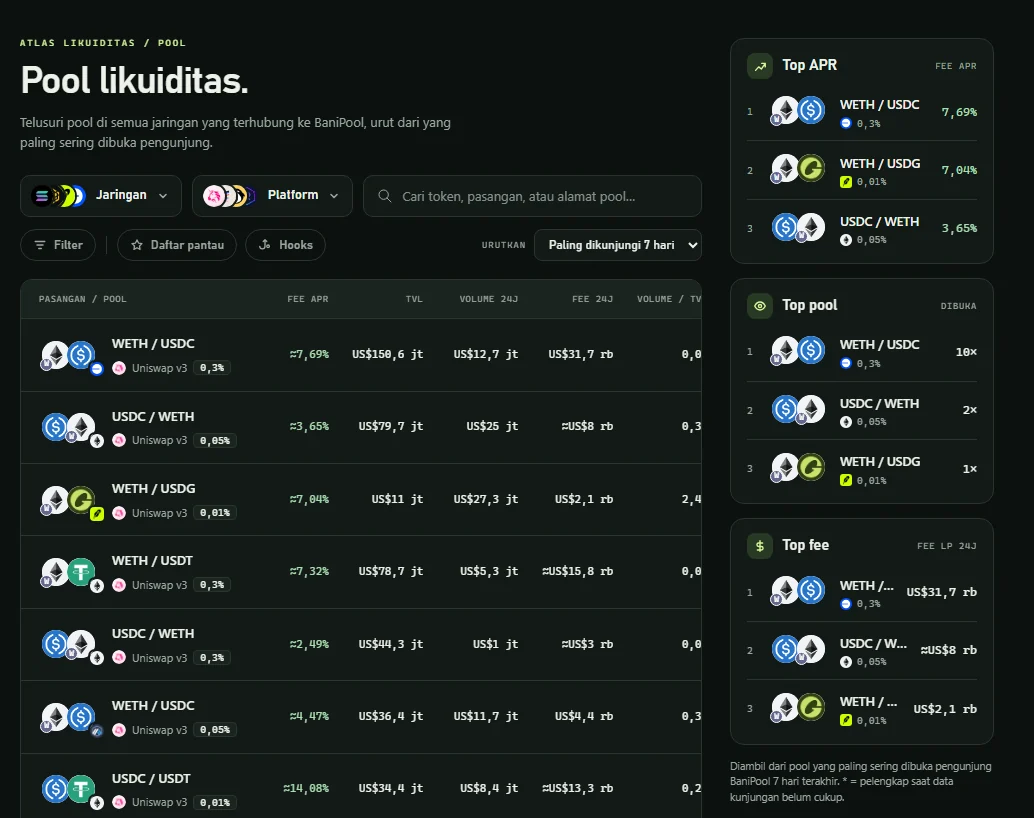
| Pool explorer | Live TVL, volume and fee APR |
| Add liquidity & create pools | Uniswap, Orca, Raydium, Meteora, PumpSwap |
| Private mempool | Protection from sandwich bots |
| Positions & PnL | Track any wallet |
BaniPool data as of November 13, 2026: 58 large pools (TVL ≥ $1M) across 8 networks, $637.3M in total.
Live data from the BaniPool index (pools with TVL ≥ $1M), refreshed every 30 minutes — full DeFi liquidity report
Meet BaniPool: explore liquidity pools on 10 networks, add liquidity, create pools, swap, use a private mempool, and track LP positions — without giving up custody.
BaniPool is a multichain DeFi liquidity pool dashboard to explore pools, add liquidity, create new pools, swap and track LP positions across 10 networks: Ethereum, Base, BNB Smart Chain, Arbitrum One, OP Mainnet, Polygon PoS, Avalanche C-Chain, Robinhood Chain, Arc and Solana. BaniPool is non-custodial: funds stay in your wallet or in protocol contracts in your name, and every transaction is signed by your own wallet.
Supported DEXes
- EVM: Uniswap v2, v3, v4 (all EVM networks), Aerodrome and Aerodrome Slipstream (Base).
- Solana: Orca Whirlpools, Raydium CLMM, Raydium CPMM, Meteora DLMM, Meteora DAMM v2, PumpSwap.
Data is read directly from the blockchain — pools, prices, positions and balances — and every number shows its source.
What you can do
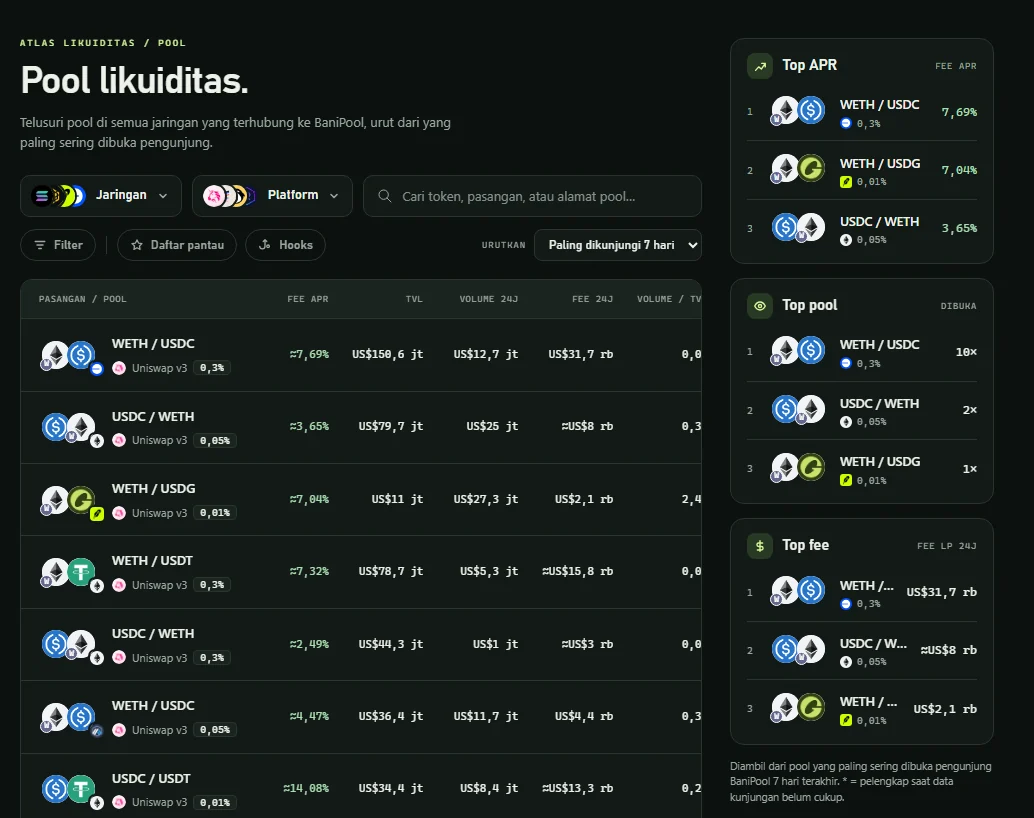
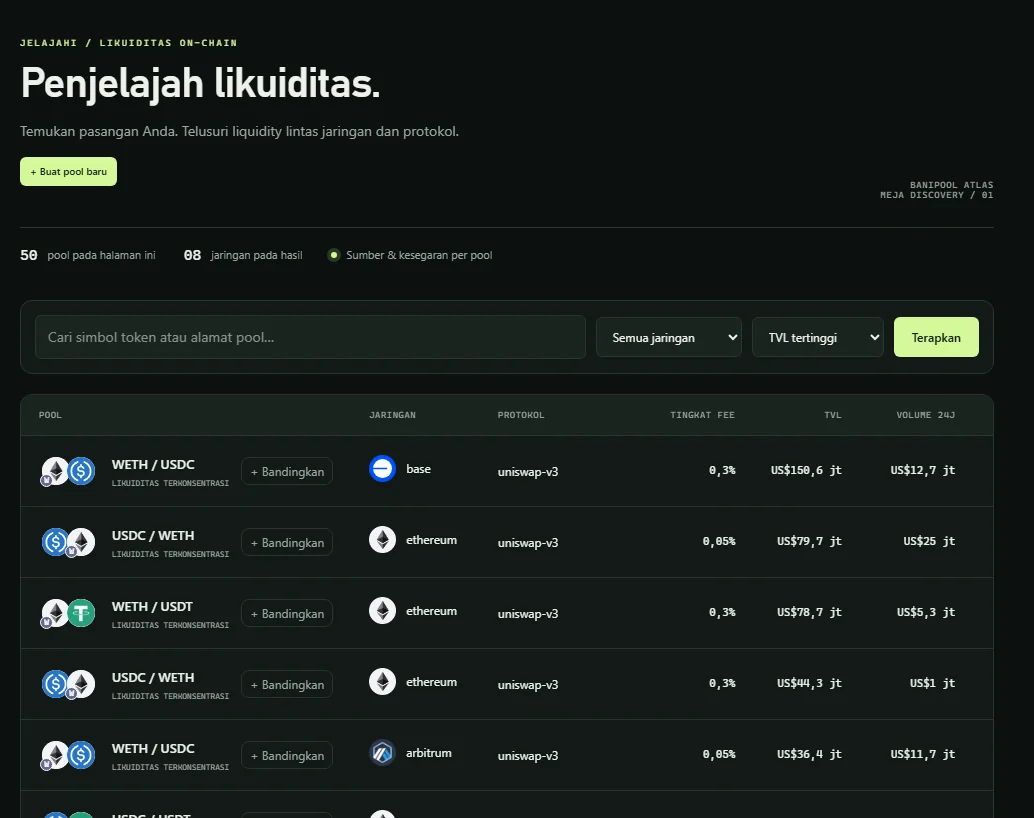
- Explore liquidity pools with TVL, volume, fee, Fee APR and an A–F security grade — see how to choose the best liquidity pool.
- Add liquidity with two tokens or Zap In with one.
- Create new pools on Uniswap or Orca/Raydium with Fee Advisor and a starting-price guard — see create a Uniswap pool and create a Solana pool.
- Private mempool: Jito on Solana; private RPCs on Ethereum and BNB Chain — see what is a sandwich attack.
- Manage positions: add, withdraw, claim fees, compound, rebalance, Zap Out.
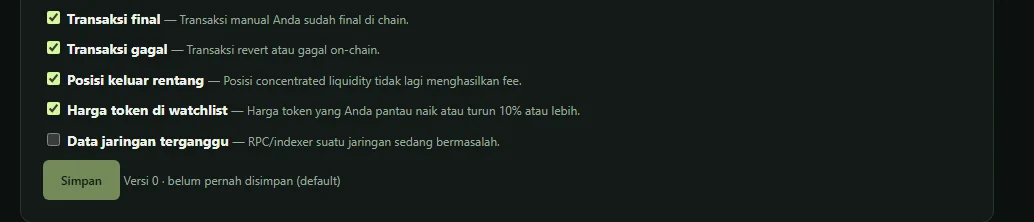
- Automation with a keeper: alerts, compound, rebalance, exit.
- Security: token & pool checks, a scam-token blacklist, and a new-pool Radar.
- Swap (including cross-chain), Bridge, stablecoin Vaults, and a developer API.
What makes BaniPool different
- EVM and Solana in one place — your profile merges LP positions from both.
- Simulation before signing — failing transactions are caught before they cost gas.
- Verifiable data — the source and time of each number are shown.
- Bot protection — Jito private mempool on Solana and private RPCs for EVM keepers.
- Three languages — Indonesian, English, 中文.
Getting started
- Install a wallet: MetaMask, Rabby, Coinbase Wallet (EVM) or Phantom, Solflare, Backpack (Solana).
- Click Connect wallet and sign the login message — no gas, no transaction permission. See how to connect your wallet.
- Pick a pool, add liquidity or Zap In, then track it in your Profile.
New to DeFi? Start with what is a liquidity pool.
FAQ
Does BaniPool hold my funds?
No. BaniPool never holds funds or private keys and never asks for a seed phrase. BaniPool contracts only route funds within the same transaction, and results go back to your wallet.
Is BaniPool free?
Browsing data, profiles and direct deposits without a swap are free. For Zap, swap and bridge, any platform fee is shown before you sign. Details in BaniPool fees and fund safety.
Which networks are supported?
Ethereum, Base, BNB Smart Chain, Arbitrum One, OP Mainnet, Polygon PoS, Avalanche C-Chain, Robinhood Chain, Arc and Solana.